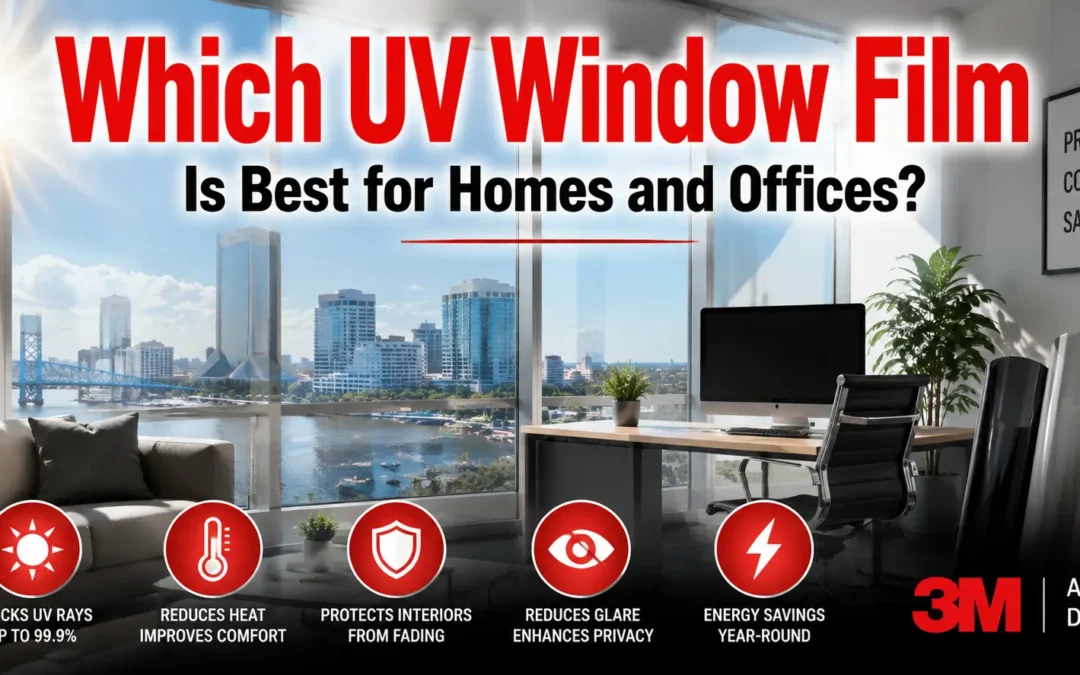
Ceramic and non-metallized solar control window films are generally the best all-around choice for homes and offices. 3M’s Prestige Series, for example, rejects up to 97% of infrared heat, up to 60% of total solar heat, and up to 99.9% of UV rays, while keeping a clear, non-tinted appearance. The right film still depends on your goal — heat control, privacy, or design — and your window’s sun exposure.
Your windows bring in natural light, but they also let in unwanted heat and UV rays. Quality UV window film can block up to 99.9% of damaging UV rays and meaningfully cut the heat coming through the glass, making indoor spaces more comfortable year-round — which matters even more in a market like Jacksonville, where south- and west-facing windows take on strong, direct sun for most of the year.
With several film categories available, choosing the right one can be confusing. Some films focus on heat reduction, others on privacy, glare control, or interior protection. The best choice depends on your window type, sun exposure, and specific goals. This guide breaks down the options so you can find the right fit for your space.
What Is UV Window Film and How Does It Work?
UV window film is a thin protective layer applied directly to glass to reduce the ultraviolet radiation, heat, and glare entering a space. Quality film filters harmful UV rays before they reach your interior, helping protect furniture, artwork, flooring, and other valuables from fading.
A professionally installed UV window film can:
- Block harmful UV radiation
- Reduce solar heat entering the space
- Minimize uncomfortable glare
- Protect furniture and interior materials from fading
- Improve overall indoor comfort
UV protection isn’t just a comfort feature — it’s a recognized sun-safety measure. Certain 3M window films have earned The Skin Cancer Foundation’s Seal of Recommendation, a designation the Foundation has awarded to sun-protection products meeting its minimum UV-blockage criteria since 1998. (3M is clear that its films haven’t been tested to prevent skin cancer specifically, so this is one layer of a broader sun-protection routine, not a stand-alone guarantee.)
Many homeowners and businesses also choose window films for double-pane windows because it adds protection while preserving the efficiency of modern glass systems. That said, not every film is suitable for every window — proper selection matters.
Types of UV Window Films for Home and Offices
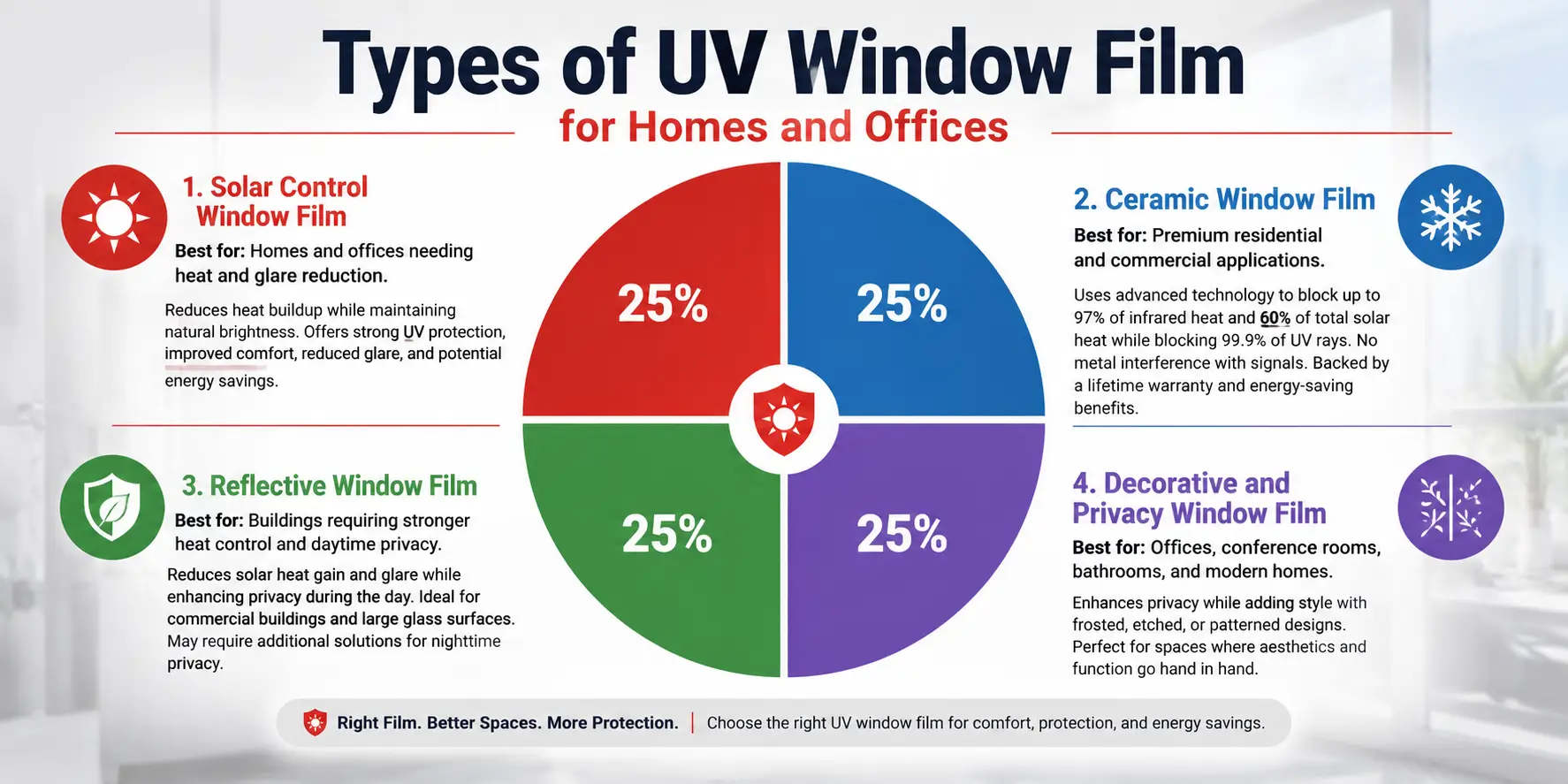
1. Solar Control Window Film
Best for: Homes and offices needing heat and glare reduction.
Solar control film is one of the most popular choices for properties exposed to strong sunlight. It reduces heat buildup while maintaining natural brightness, with benefits including strong UV protection, improved heat rejection, reduced glare, better indoor comfort, and potential energy savings. For homeowners searching for the best home window tint for heat reduction, solar control film is a strong starting point, and it’s a common choice for commercial window tinting projects where employee and visitor comfort matters.
2. Ceramic Window Film
Best for: Premium residential and commercial applications.
Ceramic and non-metallized films use advanced multi-layer optical technology to deliver strong performance without a dark, tinted appearance. 3M’s Prestige Series is a good benchmark for this category: it rejects up to 97% of infrared heat and up to 60% of total solar heat, blocks up to 99.9% of UV rays, uses no metal (so there’s no interference with WiFi, GPS, or cell signal), and carries a lifetime warranty on qualifying residential installations. 3M also states Prestige film can become carbon negative within about six months of installation, factoring in the energy savings it generates.
3. Reflective Window Film
Best for: Buildings requiring stronger heat control and daytime privacy.
Reflective window film uses a mirrored appearance to reduce sunlight and improve privacy, and is often selected for commercial buildings, offices, and properties with large glass surfaces. Benefits include reduced solar heat gain, improved daytime privacy, lower glare, and a more finished building appearance. For offices that need nighttime privacy too, an additional layer — such as blinds or a frosted film on specific windows — is usually needed, since most reflective films are strongest during daylight hours.
4. Decorative and Privacy Window Film
Best for: Offices, conference rooms, bathrooms, and modern homes.
Decorative window films combine function with style, improving privacy while adding a customized look to glass. 3M’s FASARA® and Crystal glass finish collections fall into this category, offering patterned, etched, or frosted looks that work well for conference rooms, glass partitions, and any space where privacy matters without sacrificing natural light.
| Space | Recommended Film | 3M Product Example | Main Benefit |
|---|---|---|---|
| Living rooms | Solar control film | 3M Prestige Series | Heat and glare reduction, furniture/flooring fade protection |
| Bedrooms | Ceramic film | 3M Prestige or Ceramic IR Series | Comfort and UV protection without a dark, tinted look |
| Home offices | Solar control or ceramic film | 3M Prestige Series | Reduced screen glare, steadier room temperature |
| Retail storefronts | Reflective film | 3M Prestige Exterior Series | Daytime heat control and street-level privacy |
| Conference rooms | Decorative / privacy film | 3M FASARA® or Crystal collections | Privacy and a polished, modern look |
Choosing the right UV window film depends on how a space is used. A living room may need protection from fading; an office may need better glare reduction for computer screens.
How to Choose the Right UV Window Film for Your Property
1. Consider Your Main Goal
Start by identifying what you want the film to achieve: reducing indoor heat, protecting interiors from UV damage, increasing privacy, improving appearance, or supporting energy efficiency. If temperature control is the priority, look at the best window tint options for home heat reduction; if privacy is the goal, decorative or frosted film is usually the better fit.
2. Check Window Location and Sun Exposure
South- and west-facing windows usually take the strongest sunlight throughout the day and typically call for film with stronger solar control properties. A professional installer can evaluate your specific windows and recommend a film based on orientation, glass type, and how the room is actually used.
3. Choose Quality Film and Professional Installation
The film’s quality and the installation process both directly affect performance. Professional installation helps ensure smooth application, better durability, a cleaner appearance, and full manufacturer warranty coverage — some warranties are void without certified installation.
Why Choose All Spec Sun Control for UV Window Film in Jacksonville
Jacksonville’s long, intense sun season means film selection matters more here than in milder climates — a film that isn’t matched correctly to your glass and exposure can underperform or void its warranty. All Spec Sun Control has been a family-owned window tinting business in Jacksonville since 1983 and is a 3M Authorized Dealer, meaning our installers are trained on 3M’s current Prestige, Ceramic, and decorative film lines and can recommend the right product for each room’s sun exposure and use, backed by 3M’s manufacturer warranty.
For homes, our residential window tinting service focuses on comfort, UV protection, and energy efficiency. For businesses, our commercial window tinting service helps create a more comfortable, productive environment for employees and visitors. Contact us for a free consultation and a recommendation tailored to your property.
Frequently Asked Questions
What is the best UV window film for reducing heat?
Ceramic and non-metallized solar control films, such as the 3M Prestige Series, are among the top options for heat reduction. 3M Prestige rejects up to 97% of the sun’s infrared light and up to 60% of total solar heat while still allowing natural light through, so rooms cool down without going dark.
Does UV window films help reduce energy costs?
Yes. By blocking most of the infrared heat before it reaches the glass, solar control film reduces how hard your air conditioning has to work, which can lower cooling costs, especially on south- and west-facing windows that take on the most direct Florida sun.
Can window film be installed on double-pane windows?
In most cases, yes, but the correct film has to be matched to the glass type and the manufacturer’s guidelines. Some double-pane and Low-E glass combinations require specific film types to avoid thermal stress, which is why a professional evaluation matters before installation.
Does window tint provide privacy at night?
Most reflective window films are strongest during daylight hours. After dark, once interior lights are on, that daytime one-way effect reverses, so if nighttime privacy is a priority, a frosted, etched, or decorative film is a more consistent choice than reflective film alone.
How long does window film last?
High-quality film professionally installed can last many years; 3M backs its Prestige Series with a lifetime warranty on qualifying residential installations and a 15-year warranty on commercial installations, giving you a clear benchmark for expected lifespan.
Does UV window film block harmful UV rays?
Yes. Premium films like 3M Prestige block up to 99.9% of UV rays, and certain 3M window films have earned The Skin Cancer Foundation’s Seal of Recommendation for effective UV protection. (3M notes its films are not tested to prevent skin cancer specifically, so this protection is one part of a broader sun-safety routine, not a substitute for it.)
Is ceramic window film better than regular tint?
Ceramic and non-metallized films generally offer stronger, more selective heat rejection and a clearer appearance than older dyed or metallized tints, without the risk of interference with WiFi, GPS, or cell signal that some metallized films can cause.
Can window film reduce glare on computer screens?
Yes. Solar control and ceramic films reduce the intensity of direct and reflected sunlight, which is one of the most common complaints in home offices and workspaces with west-facing windows.
Does window films make rooms darker?
Not necessarily. Spectrally selective films like 3M Prestige are designed to block heat-producing infrared and UV light while allowing a high percentage of visible light through, so rooms stay bright even with strong solar protection.
Is professional window film installation necessary?
Yes. Improper installation is the most common cause of bubbling, peeling, and premature film failure. Professional installation also ensures the correct film is matched to your specific glass type, which affects both performance and warranty coverage.