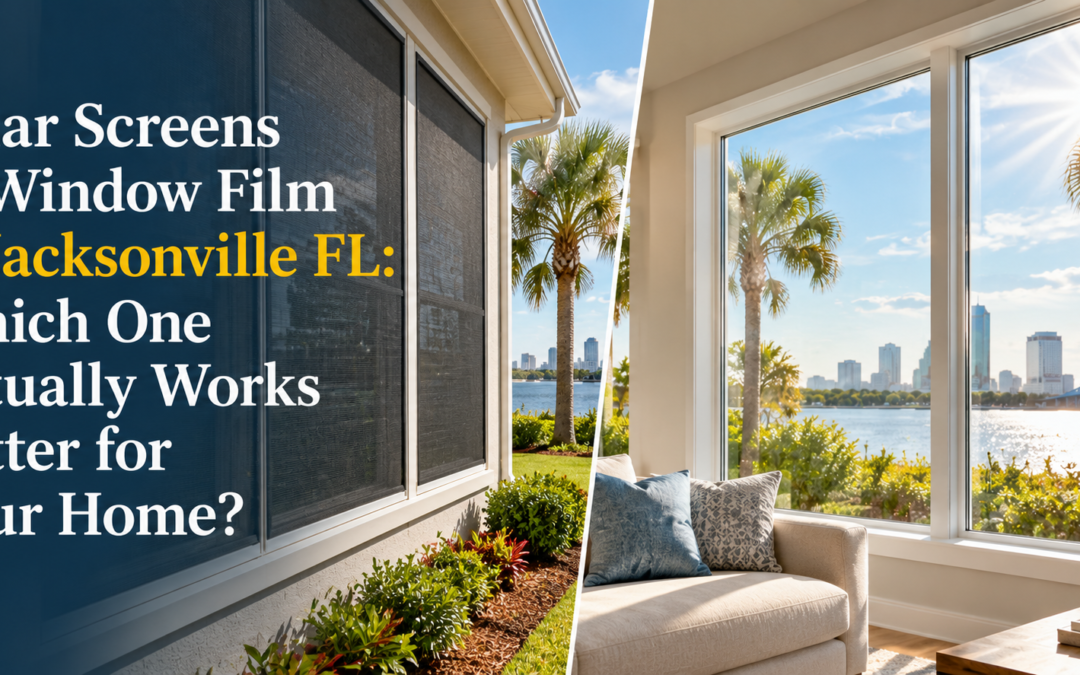
Both solar screens and window film block heat and UV rays, but window film outperforms solar screens in nearly every measurable category relevant to Jacksonville homes, including UV rejection, heat rejection, durability in coastal humidity, aesthetics, and long-term value. Solar screens are an exterior product that can be removed seasonally but offer limited UV protection and change the look of your home significantly. Window film is a permanent, interior-applied upgrade that blocks up to 99.9% of UV rays, rejects up to 97% of infrared heat, and requires no structural changes to install.
All Spec Sun Control — Family-owned in Jacksonville since 1983 | 3M Authorized Dealer | Residential and Commercial Window Film Specialists | Serving Northeast Florida for 40+ years | Free In-Home Estimates
TL;DR — Key Takeaways:
- Window film blocks up to 99.9% of UV rays, solar screens typically block 65–90% depending on density.
- Window film rejects up to 97% of infrared heat, solar screens block roughly 50–70% of solar heat gain.
- Solar screens are exterior and removable, window film is interior and permanent.
- Change your home’s exterior appearance significantly, window film maintains the natural look of the glass.
- Solar screens are more vulnerable to Florida’s wind, humidity, and salt air, quality window film carries a lifetime residential warranty.
- Window film works on every window type including fixed glass, skylights, and glass doors, solar screens require frames and hardware.
- For Jacksonville homeowners in HOA communities, window film is almost always the compliant choice.
- Both are significantly less expensive than full window replacement.
Quick Comparison: Solar Screens vs Window Film for Jacksonville Homes
| Factor | Solar Screens | Window Film |
|---|---|---|
| UV rejection | 65–90% (varies by screen density) | Up to 99.9% (premium films) |
| Infrared heat rejection | ~50–70% solar heat blocked | Up to 97% IR rejected (3M Prestige) |
| Glare reduction | Moderate — also reduces natural light significantly | Strong — targets glare without darkening room |
| Installation location | Exterior — mounted outside the window frame | Interior — applied to inside glass surface |
| Appearance impact | Visible mesh look from outside and inside | Minimal — nearly invisible on glass |
| HOA compliance | Often restricted or prohibited | Generally compliant with low-reflectivity film |
| Coastal/salt air durability | Metal frames corrode; mesh degrades faster in humidity | Non-metallized film unaffected by salt air |
| Works on all window types | No — requires frames; not suitable for skylights, fixed glass, glass doors | Yes — applies to any flat glass surface |
| Removable | Yes — seasonal removal possible | No — permanent installation |
| Maintenance | Regular cleaning required; can dent, bend, or tear | Minimal — wipe clean like regular glass |
| Typical cost installed | $15–$30 per sq ft (screen + frame + installation) | $5–$20 per sq ft depending on film type |
| Warranty | Varies — typically 5–10 years on hardware | Lifetime residential (premium non-metallized film) |
| Adds security benefit | No | Yes — security film holds glass together on impact |
| Energy savings documentation | Limited independent data | DOE-cited; up to 30% cooling cost reduction (IWFA) |
What Are Solar Screens and How Do They Work?
Solar screens are exterior window coverings made from a tightly woven mesh fabric, usually fiberglass or polyester, stretched over a metal frame and mounted on the outside of your window. The mesh is designed to intercept solar radiation before it reaches the glass itself, reducing both heat and glare inside the home.
How solar screens reduce heat:
- The mesh fabric sits between the sun and your glass, physically blocking a portion of solar radiation before it contacts the window.
- Screen density, measured as the percentage of material to open space, determines performance. A 90% density screen blocks more light and heat but also more of your view than a 70% screen.
- Heat that reaches the glass is partially absorbed by the screen rather than transmitting directly through to the interior.
- However, solar screens do not address infrared radiation as precisely as window film does, they block broadly rather than targeting specific heat-producing wavelengths.
What solar screens do not do:
- Limited window compatibility: Solar screens do not fit every window. Skylights, fixed glass panels, glass doors, casement windows, and non-standard frames may not accommodate solar screen hardware.
- Visible from both sides: The mesh remains noticeable from the street and from inside the home. This visible appearance is one reason some HOA communities restrict or prohibit solar screens.
- Limited security protection: Unlike safety or security window film, mesh screens do not provide meaningful resistance against impact, glass breakage, or forced entry.
- Regular maintenance required: Dirt, pollen, and salt deposits from Jacksonville’s coastal air can collect on the mesh. Regular cleaning is necessary to help maintain the screens’ appearance and performance.
What Is Window Film and How Is It Different From Solar Screens?
Window film is a thin, multi-layered polyester film applied directly to the interior surface of existing glass. Unlike solar screens, which sit outside the window, film bonds to the glass itself and becomes part of the window’s optical performance. Different film types are engineered to target specific wavelengths of the solar spectrum, blocking infrared heat, UV radiation, or visible light independently rather than blocking everything uniformly.
Key differences in how window film works compared to solar screens:
Wavelength-specific performance: High-performance films like 3M Prestige use multi-layer optical technology to block infrared heat and UV while passing visible light through. Solar screens block all wavelengths indiscriminately, including the visible light that brightens your room.
Interior installation: Film is applied inside, protected from wind, rain, salt air, insects, and physical damage. Solar screens are exterior and exposed to all of Jacksonville’s weather year-round.
Glass-bonded performance: Once cured, film performs as part of the glass rather than as a separate layer in front of it. This allows for more precise solar energy management without the visual interference of a mesh layer.
Universal compatibility: Film applies to any flat glass surface regardless of frame type, window size, or position, including skylights, sliders, glass doors, and fixed panels where solar screens cannot be installed.
Which Blocks More Heat — Solar Screens or Window Film?
Short answer: Window film, specifically ceramic and spectrally selective non-metallized films, blocks significantly more heat than even the densest solar screens, particularly in terms of infrared radiation, which is the primary driver of indoor heat buildup.
| Product Type | UV Rejection | Infrared / Heat Rejection | Visible Light Blocked |
|---|---|---|---|
| Solar Screen (70% density) | ~70% | ~50% solar heat | ~30% (room noticeably dimmer) |
| Solar Screen (90% density) | ~90% | ~65–70% solar heat | ~55% (significant light loss) |
| Standard Window Film | Up to 99% | ~35–50% heat rejection | Varies by VLT selection |
| Ceramic Window Film | Up to 99% | ~65–80% IR rejection | Low — room stays bright |
| 3M Prestige Series Film | Up to 99.9% | Up to 97% IR rejection | Very low — nearly clear |
| 3M Solar / Sun Control Film | Up to 99% | Up to 78% solar heat | Varies by shade selection |
The critical distinction is that solar screens block visible light heavily in order to achieve heat reduction, while quality window film, particularly 3M Prestige and ceramic films, can reject a far higher percentage of heat while allowing significantly more visible light through. This means your rooms stay bright, your views remain clear, and the heat reduction is stronger.
For Jacksonville homeowners dealing with intense afternoon sun through west-facing windows, the difference is especially noticeable. A 90% solar screen on a west-facing room significantly dims the room from mid-afternoon onward. A high-performance ceramic or 3M Prestige film on the same window rejects more heat while keeping the room bright throughout the afternoon.
Which Option Lasts Longer in Jacksonville’s Climate?
Jacksonville’s combination of heat, humidity, and coastal salt air creates a genuinely demanding environment for any exterior product, and solar screens are an exterior product.
Solar screen durability concerns in Jacksonville’s climate:
Frame corrosion: Aluminum frames used for solar screen mounting corrode over time in salt-air environments, particularly within a few miles of the coast or Intracoastal waterway.
Mesh degradation: UV exposure and humidity cause fiberglass and polyester mesh to become brittle and discolor over time, typically visible within five to eight years in Florida’s climate.
Wind damage: Florida’s storm season creates real physical risk for exterior-mounted solar screens; they can bend, tear, or detach in high winds.
Pest issues: The gap between the screen and window frame can trap debris and attract insects, requiring more frequent maintenance.
Replacement cycles: Most solar screen hardware carries a five to ten year warranty; replacement costs add up over time.
Window film durability in Jacksonville’s climate:
Interior installation protects film from all weather exposure, wind, rain, salt air, and physical impact.
Non-metallized films such as 3M Prestige and ceramic options are specifically resistant to coastal corrosion, no metal content means no oxidation risk.
Premium residential films carry lifetime warranties, meaning one investment protects your windows for the life of the home.
Maintenance is minimal, film surfaces clean like regular glass with standard non-abrasive cleaners.
Do Solar Screens or Window Film Look Better on a Jacksonville Home?
Appearance is one of the most significant practical differences between the two options, and it is the primary reason HOA communities frequently restrict solar screens.
Solar screens, exterior appearance:
The mesh is clearly visible from the street, changing the look of the home’s windows significantly.
Different screen densities create different levels of visual darkening that can look inconsistent across a home’s facade.
In Jacksonville’s many HOA-governed communities, solar screens are frequently listed as prohibited or require specific approval because of their impact on neighborhood aesthetics.
Historic neighborhoods, waterfront communities, and higher-end residential areas in Jacksonville typically do not allow visible exterior screen systems.
Window film, exterior appearance:
Low-reflectivity non-metallized films like 3M Prestige maintain the natural look of the window from the street, the glass appearance changes minimally.
Most Jacksonville HOA communities allow low-reflectivity window film because it does not alter the home’s exterior character.
From the interior, the view through the glass remains clear, film does not create the mesh pattern visible through solar screens from inside.
Which Is Better for Jacksonville HOA Communities — Solar Screens or Window Film?
Short answer: Window film, specifically low-reflectivity, non-metallized film, is almost always the HOA-compliant choice. Solar screens are frequently prohibited in Jacksonville’s HOA-governed neighborhoods because they visibly alter the exterior appearance of the home.
Jacksonville has a high concentration of HOA-governed communities, from established neighborhoods in Mandarin and Fleming Island to newer developments in Nocatee and St. Johns County. Most HOA governing documents include window treatment guidelines that regulate exterior changes to the home’s appearance. Solar screens are exterior products and fall under these regulations. Window film, applied to the interior surface of the glass, typically does not require HOA approval because it does not constitute an exterior modification in most governing documents.
When window film does require HOA notification, low-reflectivity options like 3M Prestige are almost universally approved because they maintain the glass’s natural appearance from the street. Highly reflective or mirrored films may require additional review, but these are not necessary for heat and UV performance, ceramic and Prestige-tier films outperform reflective films on both heat rejection and UV blocking without the mirror look.
What About Cost — Are Solar Screens Cheaper Than Window Film?
This is one of the most common assumptions homeowners make, that solar screens are the budget option. In reality, when you account for full installed cost including hardware, frames, and professional installation, solar screens and window film are often comparable in price, and solar screens require more frequent replacement.
| Cost Factor | Solar Screens | Window Film |
|---|---|---|
| Material + installation cost | $15–$30 per sq ft installed | $5–$20 per sq ft installed |
| Typical Jacksonville home total | $1,200–$2,500+ | $596–$1,700 depending on film type |
| Replacement frequency | Every 8–12 years typically | Lifetime (premium film) |
| Maintenance cost | Regular cleaning; occasional hardware repair | Minimal — clean like normal glass |
| Storm damage risk | Yes — can need replacement after hurricanes | No — interior installation, unaffected by storms |
| Long-term total cost | Higher — multiple replacement cycles over home life | Lower — single lifetime investment |
When viewed as a long-term investment, window film consistently offers better value in Jacksonville’s climate. Solar screens can represent meaningful ongoing cost over a 20–30 year homeownership period due to replacement cycles, hardware corrosion, and storm damage risk that doesn’t apply to interior window film installations.
When Would Solar Screens Be the Better Choice?
Honest answer: there are specific situations where solar screens are a reasonable option, and it is worth acknowledging them directly.
Rental properties with no HOA restriction: If you own a rental property in an area without HOA restrictions and want a lower upfront cost without committing to a permanent installation, solar screens are a reasonable consideration.
Covered patios and screened enclosures: Solar screen mesh is frequently used for patio enclosures and lanai screening, which is a different application than window treatment.
Temporary or seasonal use: If you want a removable option for a specific season or situation, exterior screens can be taken down and stored.
Very large openings without glass: Open-air spaces or screen porches where window film cannot be applied may use solar screen mesh effectively.
For the vast majority of Jacksonville homeowners with standard windows in a residential or HOA community, window film is the stronger solution on every relevant measure.
Which Window Film Works Best as a Solar Screen Alternative in Jacksonville?
Not all window film performs equally as a solar screen replacement. For Jacksonville homeowners making this switch, here are the film types most worth considering:
3M Prestige Series (best overall): Up to 97% infrared rejection, 99.9% UV blocking, nearly clear appearance, non-metallized construction safe for coastal environments. The strongest performance with the least visual impact. Lifetime residential warranty through All Spec Sun Control as a 3M Authorized Dealer.
Ceramic film (best value): 65–80% infrared rejection, up to 99% UV blocking, no signal interference, excellent Florida durability. Strong heat performance at a more accessible price point than Prestige-tier film.
3M Sun Control Series (strong mid-range): Up to 78% solar heat rejection with various visible light transmission options. A good balance of performance and affordability for rooms with moderate sun exposure.
Reflective solar film (daytime privacy + heat): Provides strong heat rejection and daytime privacy for street-facing windows. Note that reflective films lose their privacy effect after dark when interior lights are on, a consideration for living rooms and bedrooms.
Dual-reflective film (heat + privacy balance): Lower interior reflectivity than standard reflective film, maintaining more of the outward view while still providing meaningful daytime privacy and heat rejection.
Why Jacksonville Homeowners Choose All Spec Sun Control for Window Film
40+ years in Jacksonville: Family-owned and operating since 1983. Window film is not a side service, it is everything we do, for every type of home and building in Northeast Florida.
3M Authorized Dealer: Every 3M film installation comes with authentic manufacturer documentation, verified installation standards, and warranty support directly through 3M. Authentic film with a real warranty, not off-brand alternatives.
Local climate expertise: After four decades in Jacksonville, we understand exactly how coastal humidity, salt air, and Florida’s year-round sun affect film performance and longevity. Our film recommendations are based on your specific window orientation, glass type, and neighborhood, not a generic product catalog.
Lifetime residential warranty: Premium non-metallized films installed by All Spec carry manufacturer-backed lifetime residential warranties. One installation, permanent protection.
Free in-home estimates: Every project starts with a no-obligation site evaluation, including glass compatibility check, window orientation analysis, and honest film recommendation before any commitment is made.
HOA navigation experience: We know Jacksonville’s HOA landscape and can advise on which films meet the appearance standards of your specific community before installation begins.
Ready to Replace Solar Screens With a Better Long-Term Solution?
All Spec Sun Control has been Jacksonville’s trusted window film specialist since 1983. As a 3M Authorized Dealer, every installation comes with manufacturer-backed lifetime warranty coverage and 40+ years of local expertise. Whether you are switching from solar screens or starting fresh, the process begins with a free, no-obligation in-home estimate.
Frequently Asked Questions
1. Which is better for blocking heat, solar screens or window film?
Window film outperforms solar screens on heat rejection in most comparisons. High-performance ceramic and 3M Prestige films reject up to 97% of infrared radiation, the primary heat-producing wavelength, while solar screens block 50–70% of total solar heat depending on mesh density. Window film also maintains better visible light transmission, meaning rooms stay brighter while rejecting more heat than a comparable solar screen installation.
2. Do solar screens block more UV than window film?
No. Premium window film blocks up to 99.9% of UV radiation. Solar screens typically block 65–90% of UV depending on mesh density, meaning 10–35% of UV rays still reach your glass and enter the room. For homeowners concerned about furniture fading, flooring discoloration, and artwork protection, window film provides meaningfully stronger UV protection at every price point.
3. Are solar screens allowed in Jacksonville HOA communities?
Many Jacksonville HOA communities restrict or prohibit solar screens because they alter the exterior appearance of the home. Window film, applied to the interior glass surface, typically does not require HOA approval since it does not constitute an exterior modification. Low-reflectivity films like 3M Prestige are almost universally compliant where any film review is required.
4. Is window film more expensive than solar screens?
Not necessarily. Solar screens cost $15–$30 per square foot installed including frames and hardware. Window film ranges from $5–$20 per square foot depending on film type. When you account for solar screen replacement cycles over time, storm damage risk, and hardware corrosion in coastal environments, window film typically represents better long-term value, especially with a lifetime residential warranty on premium film.
5. Can window film be installed on all windows where solar screens cannot fit?
Yes. Window film applies to any flat glass surface, skylights, fixed glass panels, sliding glass doors, casement windows, glass sidelites, and non-standard shapes where solar screen frames cannot be mounted. This makes film a more universally applicable solution for whole-home coverage.
6. Does window film make rooms darker like solar screens do?
Not to the same degree. Solar screens physically block visible light uniformly, a 90% density screen removes most of the view and significantly dims the interior. High-performance window films like 3M Prestige and ceramic films are designed to block infrared heat and UV while maintaining high visible light transmission, keeping rooms bright while rejecting significantly more heat than solar screens achieve.
7. How long does window film last compared to solar screens in Florida?
Premium non-metallized window film carries a lifetime residential warranty and can last 20+ years when professionally installed. Solar screens typically carry 5–10 year hardware warranties and experience faster degradation in Florida’s heat, humidity, and coastal salt air, including frame corrosion, mesh discoloration, and physical damage from storm winds.
8. Can I get both heat rejection and privacy with window film instead of solar screens?
Yes. Reflective and dual-reflective window films provide daytime privacy alongside strong heat rejection, all in a single interior-applied film. For rooms where both heat control and privacy are priorities, window film delivers both without the exterior mesh appearance of solar screens. Note that reflective privacy films lose their one-way effect after dark when interior lights are on, for full-time privacy, frosted or decorative film is the stronger option.
9. What is the best window film to replace solar screens on west-facing windows?
For west-facing windows that receive intense afternoon sun, 3M Prestige Series or high-performance ceramic film delivers the strongest heat rejection while maintaining a clear view and bright interior. These films reject up to 97% of infrared heat, outperforming even the densest solar screen available, while carrying a lifetime residential warranty when professionally installed by a 3M Authorized Dealer.
10. Does All Spec Sun Control install window film as a solar screen alternative in Jacksonville?
Yes. All Spec Sun Control has been installing residential and commercial window film in Jacksonville since 1983 as a 3M Authorized Dealer. Free in-home estimates include a complete window assessment, film recommendation based on orientation and glass type, and guidance on which options meet your HOA’s appearance requirements.