Safety and security window film does not prevent glass from breaking, but it holds shattered glass together on impact — significantly slowing forced entry, reducing flying glass injuries during storms, and making smash-and-grab theft measurably harder. It is not the same as laminated glass, but quality safety film meets ANSI Z97.1 safety standards and costs 60–80% less than full glass replacement. For commercial window tinting in Jacksonville, professional installation typically costs $8–$20 per square foot depending on film type, with most commercial projects running $1,500–$6,000+ depending on building size and film selection.
All Spec Sun Control — Family-owned in Jacksonville since 1983 | 3M Authorized Dealer | Residential and Commercial Window Film Specialists | Serving Northeast Florida for 40+ years | Free In-Home and On-Site Estimates
TL;DR — Key Takeaways:
- Safety film holds shattered glass in place — it does not make glass unbreakable, but forces an intruder to spend significantly more time and effort breaking through
- Shatter-resistant film and safety film are the same category of product — the terms are used interchangeably in the industry
- Safety film is not as structurally strong as laminated glass — but it costs 60–80% less and installs in hours without structural changes
- Solar-security combination films provide both heat rejection and glass retention in a single layer — the most practical option for most Jacksonville homes and businesses
- Commercial window tinting in Jacksonville typically costs $8–$20 per square foot installed, with most commercial projects totaling $1,500–$6,000+
- Commercial window film reduces cooling costs by up to 30% and eliminates the screen glare that reduces employee productivity near windows
- All three major questions from your GSC — “is shatter resistant film the same as safety film”, “does glass door film stop intruders”, and “is safety glazing film as strong as laminated glass” — are answered directly in this guide
Quick Facts: Safety Film and Commercial Tinting in Jacksonville FL
| Detail | Data |
|---|---|
| Safety film thickness range | 4 mil (basic) to 14+ mil (heavy security) |
| Safety standard met by quality film | ANSI Z97.1 / CPSC 16 CFR 1201 |
| Cost vs. laminated glass replacement | Film is 60–80% less expensive |
| Commercial film cost per sq ft (installed) | $8–$20 depending on film type |
| Typical commercial project total | $1,500–$6,000+ depending on building size |
| Commercial cooling cost reduction | Up to 30% (IWFA) |
| UV rays blocked (commercial solar film) | Up to 99.9% |
| IR heat rejection (3M Prestige commercial) | Up to 97% |
| Commercial film warranty (3M) | Up to 15 years |
| Installation disruption | Minimal — most commercial installs completed in 1–3 days |
| Permits typically required | No — film does not constitute a structural change in most Jacksonville applications |
| Jacksonville sunny days per year | 233+ average |
What Is Safety and Security Window Film and How Does It Work?
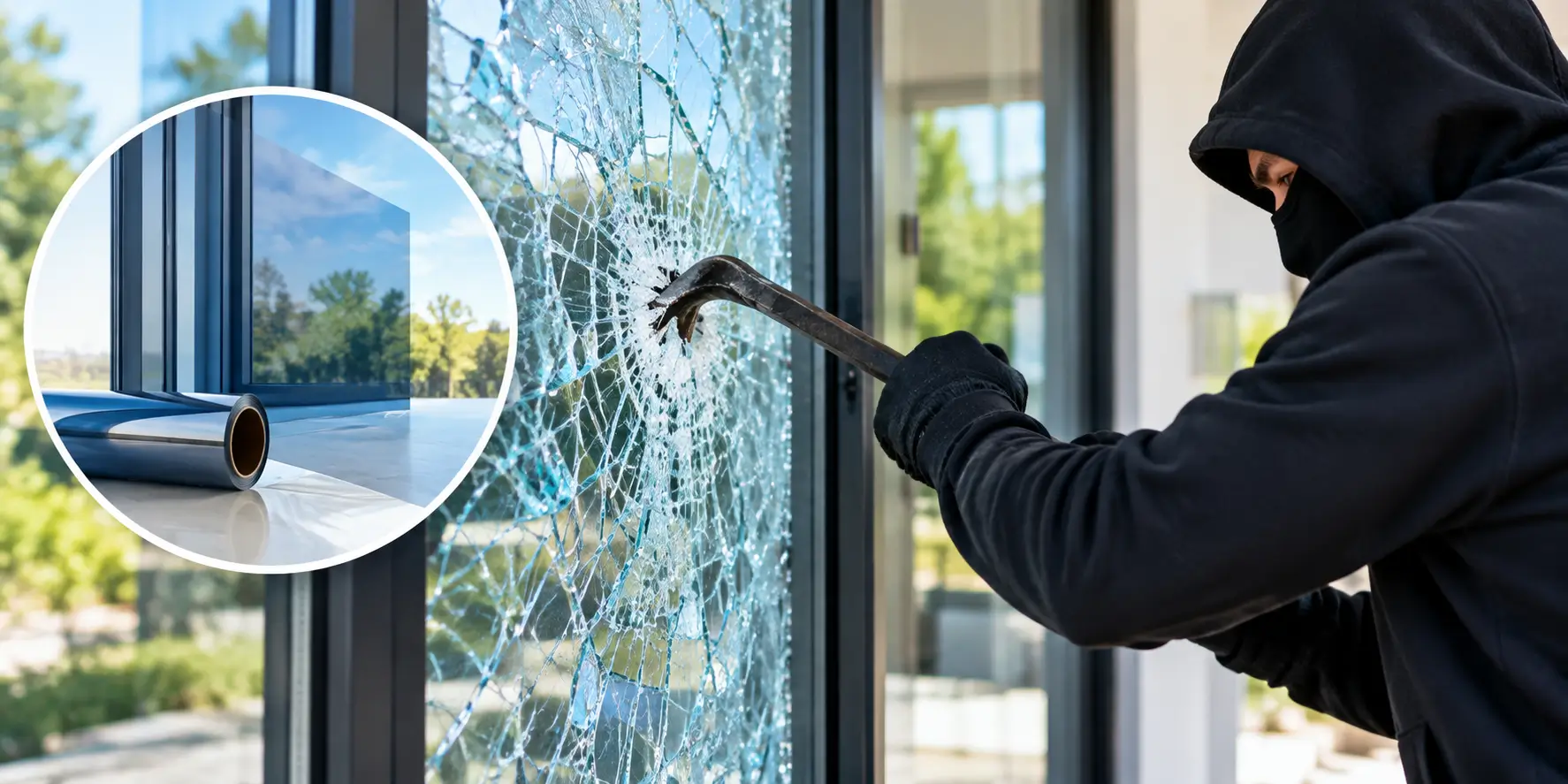
Safety and security window film is a thick, adhesive-backed polyester film applied directly to existing glass that is engineered to hold shattered glass together on impact. When glass treated with safety film breaks — whether from a thrown object, storm debris, attempted forced entry, or accident — the film holds the fragments in place rather than allowing them to scatter or fall inward.
This is fundamentally different from how standard window film works. Solar control films (used for heat and UV rejection) are typically 2–4 mil thick and are engineered around optical performance. Security films are 4–14 mil thick or more and are engineered around tensile strength and adhesive bonding to the glass surface.
How security film slows a break-in:
- When glass is struck, the film holds the fragments together in the frame rather than allowing the pane to collapse inward — the hole that forms is smaller, jagged, and structurally held by the film
- An intruder must strike the glass repeatedly and with increasing force to create an opening large enough to reach through or climb through
- This additional time and noise significantly increases the risk of detection — most opportunistic break-ins are abandoned when entry takes longer than 60 seconds
- Glass door film specifically addresses the most common entry point for smash-and-grab incidents — the glass panel adjacent to or within the door itself
What security film cannot do:
- It cannot make glass unbreakable — a determined intruder with sufficient time and tools can break through any glass regardless of film
- It cannot replace the structural strength of laminated glass in certified hurricane impact zones
- It cannot prevent the locking mechanism from being compromised through other means
- It is a deterrent and delay measure — not an impenetrable barrier
Is Shatter Resistant Film the Same as Safety Film?
Short answer: Yes — “shatter resistant film,” “safety film,” “safety glazing film,” and “security film” all refer to the same general category of thick, impact-resistant window film. The terminology varies by manufacturer and application, but the underlying product is the same type: a polyester film engineered to hold broken glass in place.
There is a meaningful performance distinction within this category based on thickness and application:
| Film Term | Typical Thickness | Primary Purpose | Common Application |
|---|---|---|---|
| Safety Film | 4–7 mil | Injury prevention from accidental breakage | Homes with children, patio doors, skylights |
| Shatter Resistant Film | 4–8 mil | Same as safety film — terminology used interchangeably | Residential and light commercial |
| Security Film | 8–14 mil | Forced entry resistance and storm protection | Commercial storefronts, ground-floor office glass |
| Anti-Intrusion Film | 12–21 mil | Maximum delay against sustained forced entry | Banks, government buildings, high-security commercial |
| Solar-Security Combination | 6–10 mil | Heat rejection + glass retention in one layer | Homes and offices wanting both benefits |
| Blast-Rated Film | 14–21+ mil | Protection against explosive pressure waves | Government, military, critical infrastructure |
For most Jacksonville homeowners and businesses, the practical choice is between standard safety film (4–8 mil), standard security film (8–14 mil), or a solar-security combination film that provides meaningful heat rejection alongside glass retention. The right choice depends on whether the primary concern is storm protection, forced entry deterrence, or both.
Is Safety Glazing Film as Strong as Laminated Glass?
Short answer: No — laminated glass is structurally stronger than safety film for forced entry resistance because the interlayer is permanently bonded within the glass itself during manufacturing. However, safety film meets recognized safety standards, costs dramatically less, installs on existing windows in hours, and provides meaningful protection that is appropriate for the vast majority of Jacksonville residential and commercial applications.
| Factor | Safety / Security Film | Laminated Glass |
|---|---|---|
| Structural strength | Significant improvement over untreated glass; holds fragments on impact | Superior — interlayer is part of the glass structure itself |
| Forced entry resistance | Slows and deters — delays a determined intruder meaningfully | Higher resistance; more robust under sustained attack |
| Florida hurricane zone certification | Does not replace certified impact glass in required zones | Can meet Florida building code impact requirements |
| Flying glass injury reduction | Excellent — holds fragments in place | Excellent — interlayer prevents fragment scatter |
| Installation method | Applied to existing glass — no frame removal, no structural work | Full window replacement — frames removed, new unit installed |
| Installation timeline | Hours — most homes completed same day | Days to weeks per project scope |
| Cost per square foot | $8–$16 installed (film) | $25–$100+ per sq ft (new laminated glass + installation) |
| Business disruption | Minimal — business can operate during installation | Significant — window removal requires closure or protection |
| UV protection added | Yes — combination films block up to 99.9% UV | Limited — depends on glass specification |
| Heat control added | Yes — solar-security combo films available | Minimal unless specifically specified at purchase |
| Reversible | Yes — film can be replaced or upgraded | No — permanent structural change |
| Permits required | Typically none for residential film | Usually required — structural window replacement |
When to choose safety film over laminated glass:
- Your windows are structurally sound and do not need replacement for any other reason
- Budget is a meaningful factor — film is 60–80% less expensive than glass replacement
- You want heat control and UV protection alongside security — combination films deliver all three
- Minimal installation disruption is important — a home or business can remain fully operational during film installation
- You want an upgradeable solution — film can be replaced with a higher specification if needs change
When laminated glass makes more sense:
- You are in a Florida-designated hurricane impact zone where certified impact glass is required by building code
- Existing glass is already damaged, fogged between panes, or has seal failure requiring replacement regardless
- Maximum forced entry resistance — rather than delay — is the non-negotiable priority for a high-risk commercial application
Does Glass Door Film Stop Intruders?
Glass door film does not stop a determined intruder — no window product does — but it significantly increases the time, effort, and noise required to break through, which is the most effective deterrent against opportunistic break-ins. Most residential burglaries and commercial smash-and-grab incidents are abandoned when entry is not achieved within 60 seconds.
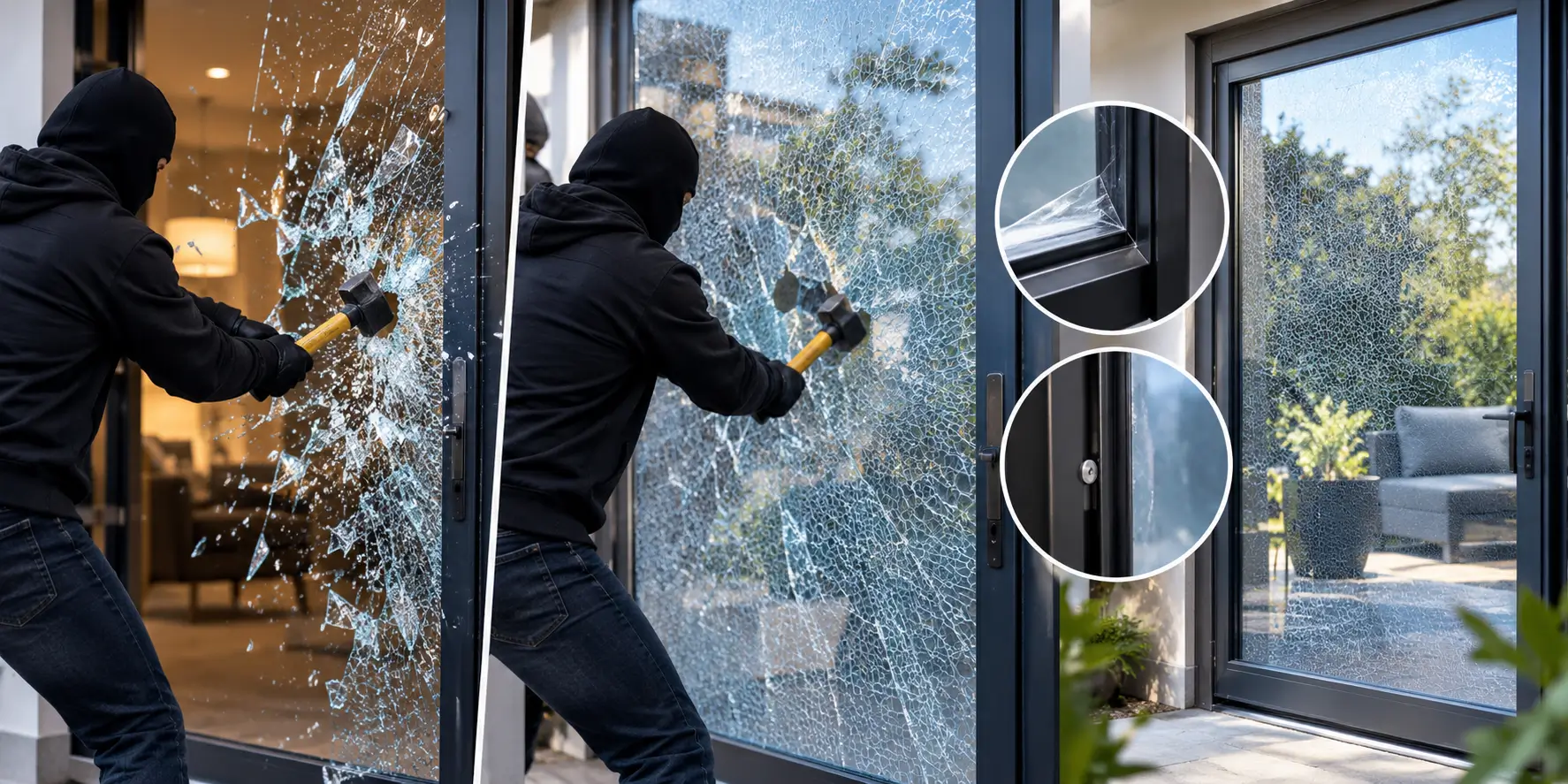
Glass doors — sliding patio doors, French door glass panels, glass sidelights adjacent to front doors, and storefront glass — represent the most common entry points for both residential and commercial break-ins. Standard glass shatters cleanly and collapses quickly when struck with a blunt object, creating an opening within seconds. Glass treated with quality security film behaves very differently:
- The first strike creates a fracture pattern but the glass remains in the frame, held by the film
- Subsequent strikes gradually degrade the film’s hold, but the process is slower and louder than breaking untreated glass
- The opening that eventually forms is irregular, partially held by film, and significantly more difficult to reach through safely than a clean break
- For sliding glass doors — one of the most common residential entry points — the film on the fixed panel and the moveable panel both need to be treated to meaningfully address the vulnerability
For maximum glass door security: 8–14 mil security film combined with an edge-anchoring system (where the film is mechanically attached to the frame rather than relying solely on adhesive) provides the strongest film-based protection available for existing glass. All Spec Sun Control can advise on frame anchoring options during a free in-home estimate.
What Is the Difference Between Solar Film and Security Film?
This is one of the most frequently asked questions from Jacksonville homeowners and business owners considering window film for the first time — and it is worth answering precisely because the products are engineered for fundamentally different purposes.
| Property | Solar Control Film | Security Film | Solar-Security Combination |
|---|---|---|---|
| Primary engineering goal | Block infrared heat and UV radiation | Hold glass together on impact | Both — heat control + glass retention |
| Typical thickness | 2–4 mil | 8–14 mil | 6–10 mil |
| Infrared heat rejection | Up to 97% (3M Prestige) | Minimal | Meaningful — varies by product |
| UV rejection | Up to 99.9% | Moderate | Up to 99% |
| Impact resistance | Minimal — not designed for this | High — primary purpose | Good — meaningful delay |
| Storm protection | Minimal glass retention | Strong — holds fragments in frame | Strong — holds fragments in frame |
| Appearance | Clear to slight tint; low reflectivity options | Typically clear — minimal visual impact | Slight tint; varies by product |
| Best for | Heat and UV reduction, energy savings | Forced entry deterrence, storm safety | Homes and offices wanting both benefits |
The most practical recommendation for most Jacksonville homeowners: A solar-security combination film addresses both the energy performance gap and the glass safety gap in a single installation. Rather than choosing between a film that blocks heat and one that holds glass together, combination films deliver both — which is why they are increasingly the default recommendation for whole-home residential installations and commercial ground-floor glass in Jacksonville.
What Is the Best Solar Security Film for Jacksonville Homes?
For Jacksonville homeowners who want both heat rejection and security protection in one film, here are the options worth considering:
- 3M Safety Series (S40, S70, S140) — 3M’s dedicated safety and security film line. S40 is a 4-mil safety film suitable for injury prevention and light security; S70 is a 7-mil film offering stronger impact resistance; S140 is a 14-mil heavy security film for applications requiring maximum glass retention. All are compatible with solar film overlays for combination performance.
- 3M Solar Safety Combination Films — 3M produces combination products that integrate solar control and safety film performance in a single layer. These are the most convenient option for homeowners wanting one installation that addresses both needs simultaneously.
- Ceramic safety film — Ceramic-based films with safety-rated thickness provide strong heat rejection alongside meaningful impact resistance. These perform well in Florida’s coastal environment because ceramic construction eliminates the corrosion risk of metal-containing alternatives.
- Non-metallized solar-security film — For HOA communities and smart homes, non-metallized combination films avoid both the reflective appearance that some communities restrict and the WiFi interference that metalized films can cause, while still providing meaningful heat and security performance.
All Spec Sun Control carries 3M safety and security film as a 3M Authorized Dealer — with authentic manufacturer documentation and warranty support on every installation. Film selection for security applications should be done with a site assessment, since glass type, frame construction, and the specific security concern all affect which product is most appropriate.
How Much Does Commercial Window Tinting Cost in Jacksonville FL?
Commercial window tinting cost in Jacksonville varies based on four primary factors: film type, total glass square footage, building height and window accessibility, and whether existing film needs to be removed first. Here is a complete cost breakdown for 2026.
| Film Type | Cost Per Sq Ft (Installed) | Primary Benefit | Common Applications |
|---|---|---|---|
| Standard Solar Control Film | $8–$12 | Heat and glare reduction | Offices, retail, medical waiting rooms |
| Ceramic Solar Film | $10–$15 | Superior heat rejection, no signal interference | Tech offices, smart buildings, HOA properties |
| 3M Prestige Commercial | $14–$20 | Maximum IR rejection, near-clear appearance | High-rise offices, premium commercial buildings |
| Security / Safety Film | $10–$16 | Glass retention, forced entry delay | Ground-floor storefronts, banks, schools |
| Decorative / Frosted Film | $8–$14 | Privacy and branding | Conference rooms, glass partitions, storefronts |
| Reflective / One-Way Film | $9–$14 | Daytime privacy + heat reduction | Street-facing windows, waiting areas |
| Solar-Security Combination | $12–$18 | Heat control + glass safety in one layer | Ground-floor commercial glass with sun exposure |
Typical total commercial project costs in Jacksonville:
| Building Type | Approximate Total Cost | Notes |
|---|---|---|
| Small retail unit (1–2 storefront windows) | $400–$900 | Standard solar or security film |
| Single-floor office suite (6–12 windows) | $1,200–$2,800 | Solar control or ceramic film |
| Medical or professional office (full floor) | $2,500–$5,500 | Combination film across multiple exposure directions |
| Multi-floor commercial building | $5,000–$15,000+ | Varies significantly by glass area and film type |
| Restaurant with large street-facing glass | $1,500–$4,000 | Solar control + decorative combination |
| Commercial building (security film, ground floor only) | $1,200–$3,500 | Security film on entry-level glass only |
What affects commercial window tinting cost:
- Film type — the single biggest variable; standard solar film at $8/sq ft vs. 3M Prestige at $20/sq ft makes a significant difference on large glass areas
- Total glass area — larger projects typically get better per-square-foot pricing due to installation efficiency
- Building height — upper-floor windows requiring lifts or special access equipment add meaningful labor cost
- Glass type — certain films are not compatible with all double-pane configurations; a site assessment confirms compatibility before installation
- Old film removal — if existing film needs to be stripped before new film is applied, this adds labor time and cost
- Window shape complexity — arched, angled, or non-standard window shapes require custom cutting and add installation time
Why Are Jacksonville Businesses Investing in Commercial Window Tinting in 2026?
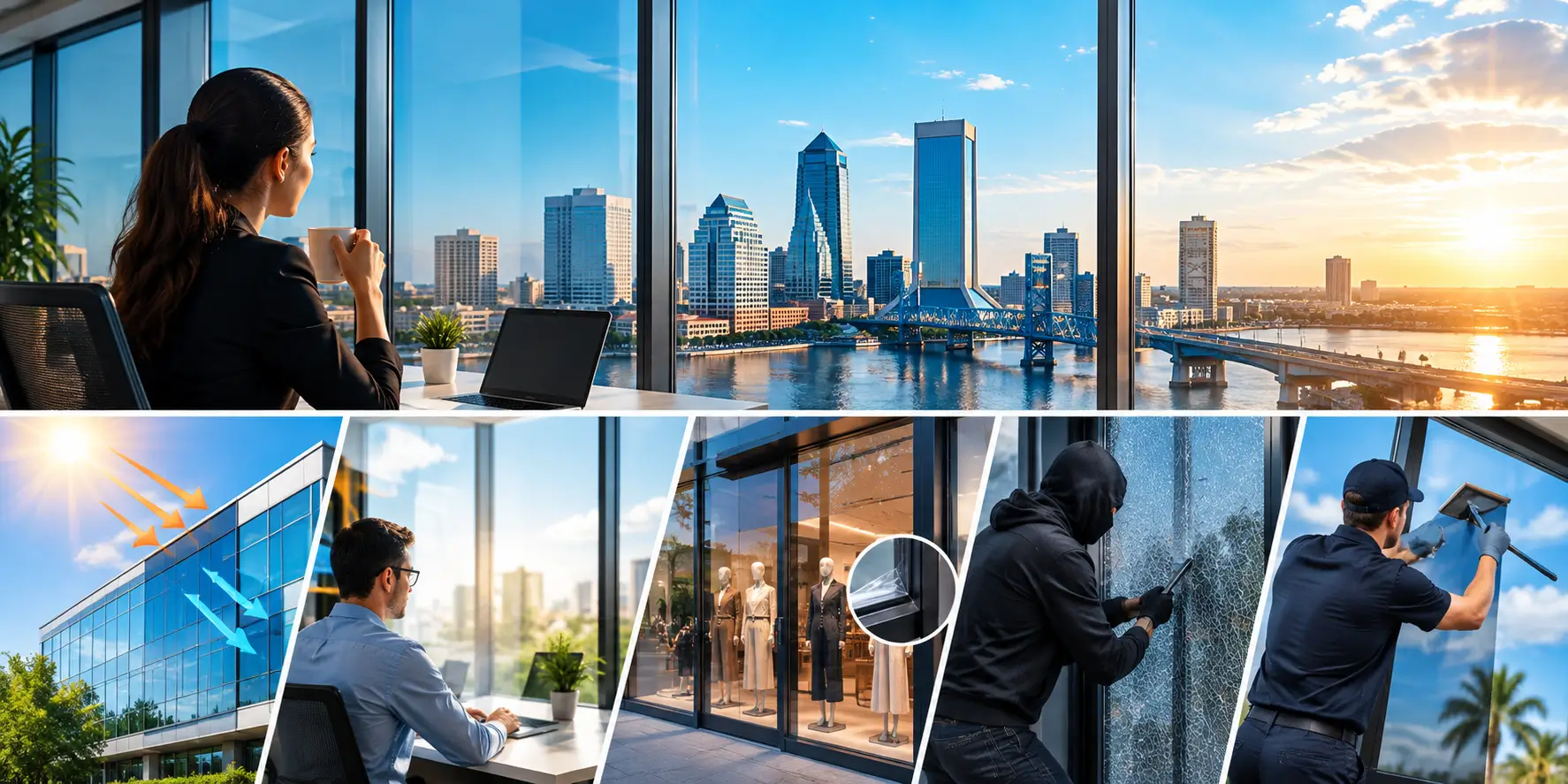
Commercial window tinting in Jacksonville has shifted from a comfort upgrade to a measurable operational cost decision. For office buildings, retail spaces, medical facilities, and commercial properties with significant south- or west-facing glass, the financial case is increasingly straightforward.
Energy cost reduction:
- Solar heat gain through windows accounts for approximately one-third of commercial cooling costs, per 3M’s building data
- High-quality commercial solar films can reject between 50% and 80% of solar heat, directly reducing HVAC cycling frequency
- The International Window Film Association documents up to 30% cooling cost reduction in high-heat commercial applications
- The U.S. Department of Energy cites commercial window film as one of the fastest-payback energy conservation technologies, with a typical three-year payback period
- Jacksonville’s long cooling season — air conditioning running for approximately eight to ten months annually — compresses that payback timeline further
Employee productivity and comfort:
- Glare on computer screens is one of the most commonly reported workplace comfort complaints in glass-heavy offices
- West-facing offices in Jacksonville frequently become unusable from glare and heat during afternoon hours without film — a direct productivity impact
- Window film eliminates hot spots near windows and reduces screen glare without requiring blinds that block natural light and the view
- Consistent indoor temperatures improve throughout the work day, reducing the uneven distribution caused by direct solar exposure on part of the floor plate
Asset and merchandise protection:
- Commercial UV-blocking film protects displayed merchandise, retail flooring, office furniture, and patient waiting area furnishings from fading — a direct financial consideration for any customer-facing space
- UV damage to commercial interiors is cumulative and largely invisible until it becomes severe — film prevents it rather than addressing it after the fact
Ground-floor security:
- Security film on ground-floor commercial glass is increasingly included in commercial insurance loss prevention recommendations
- Jacksonville’s retail and restaurant corridors have seen increased smash-and-grab incidents — security film on storefront glass is one of the most cost-effective deterrents available
- Unlike alarm systems, security film is a passive protection layer that does not require monitoring fees or battery maintenance
How Do You Find the Right Window Tinting Company in Jacksonville FL?
Whether you are searching for window tinting near me in Jacksonville, looking for the best window tinting Jacksonville FL has to offer, or specifically need commercial building window tinting for a business property — the criteria that matter most are consistent:
- Manufacturer authorization — An authorized 3M dealer installs authentic film with documented manufacturer warranties. Non-authorized installers may use off-brand film sold as equivalent, without enforceable warranty support.
- Local experience — Jacksonville’s coastal proximity, HOA concentration, and year-round UV exposure create specific installation considerations. A local installer with decades of Jacksonville-specific experience understands these factors in ways a national franchise may not.
- Free in-home or on-site estimates — Reputable window tinting companies in Jacksonville provide no-obligation site assessments that include glass compatibility evaluation, film recommendation based on your specific window orientation and building type, and honest pricing before any commitment.
- Documented warranty — Lifetime residential warranty and up to 15-year commercial warranty on premium 3M film. Always ask for this documentation before signing off on an installation.
- Portfolio of commercial and residential work — The best window tinting companies in Jacksonville FL handle both residential home window tinting services and large commercial projects. Experience across both segments indicates genuine expertise rather than a narrow specialization.
Why Jacksonville Homeowners and Businesses Choose All Spec Sun Control
- Family-owned since 1983 — 40+ years of continuous operation in Jacksonville. Window film is the only thing we do — not a side service added to a broader contractor offering.
- 3M Authorized Dealer — Every installation uses authentic 3M film with manufacturer documentation and warranty support directly through 3M. This matters for both residential lifetime warranties and commercial 15-year warranties.
- Residential and commercial expertise — From single-room home installations to multi-story commercial buildings across Jacksonville, Orange Park, Fleming Island, Mandarin, and the Beaches, All Spec handles projects of all scales.
- Security film specialists — Safety and security film installation requires specific knowledge of glass type, frame compatibility, and anchoring options that not every installer has. All Spec’s 40+ years of experience includes security film for both residential and commercial applications.
- Free estimates — residential and commercial — Every project begins with a no-obligation site evaluation that includes glass compatibility assessment, orientation analysis, film recommendation, and transparent pricing before any decision is made.
FAQ
Does glass door film stop intruders from breaking in?
Glass door film does not stop intruders — no film product makes glass unbreakable. What it does is hold shattered glass in place on impact, forcing an intruder to spend significantly more time and effort creating an opening. Since most opportunistic break-ins are abandoned when entry takes more than 60 seconds, the delay effect is the practical security benefit. For sliding glass doors and storefront glass — the most common break-in entry points — 8–14 mil security film provides meaningful deterrence.
Is shatter resistant film the same as safety film?
Yes — “shatter resistant film,” “safety film,” “safety glazing film,” and “security film” all refer to the same product category: thick polyester film engineered to hold broken glass fragments together on impact. The terminology varies by manufacturer and application, but the product function is identical. The key variable within this category is thickness — ranging from 4 mil for basic safety applications to 14+ mil for heavy security installations.
Is safety glazing film as strong as laminated glass?
No — laminated glass has the interlayer permanently bonded within the glass structure and is structurally stronger for forced entry resistance. However, safety film meets ANSI Z97.1 safety standards, provides meaningful storm and security protection, installs in hours on existing windows, and costs 60–80% less than laminated glass replacement. For most Jacksonville residential and commercial applications, quality safety film delivers appropriate protection without the cost and disruption of full window replacement.
What is the difference between solar film and security film?
Solar control film is 2–4 mil thick and engineered to block infrared heat and UV radiation — it provides minimal impact resistance. Security film is 8–14 mil thick and engineered to hold glass together on impact — it provides minimal heat control on its own. Solar-security combination films address both needs in a single layer and are the most practical option for Jacksonville homeowners and businesses wanting both energy savings and safety protection simultaneously.
How much does commercial window tinting cost in Jacksonville FL?
Commercial window tinting in Jacksonville typically costs $8–$20 per square foot installed, depending on film type. A single-floor office suite runs approximately $1,200–$2,800. A medical or professional office covering a full floor typically runs $2,500–$5,500. Multi-floor commercial buildings vary significantly based on total glass area and film specification. Free on-site estimates from All Spec Sun Control provide accurate pricing before any commitment.
What type of commercial window film reduces energy costs the most?
High-performance ceramic and spectrally selective films — such as 3M Prestige commercial — provide the strongest heat rejection, rejecting up to 97% of infrared radiation and up to 60% of total solar heat. The International Window Film Association documents up to 30% commercial cooling cost reduction from quality solar control film in high-heat climates, with a DOE-cited payback period of approximately three years.
Can window film be installed on commercial buildings without permits in Jacksonville?
In most Jacksonville commercial applications, window film installation does not require a building permit because it does not constitute a structural modification to the building. This makes commercial window film significantly faster and less disruptive to install than other building efficiency upgrades. Specific situations — such as designated historic buildings or projects covered by specific commercial lease terms — may have additional requirements that a site assessment can identify.
What is the best security film for Jacksonville businesses with ground-floor glass?
For commercial ground-floor applications in Jacksonville — storefronts, restaurant entries, retail windows, lobby glass — 8–14 mil security film with edge anchoring is the strongest film-based option available. Solar-security combination films are increasingly preferred because they address both the heat gain from Jacksonville’s intense sun and the glass retention needed for ground-floor security in a single installation.
How long does commercial window film installation take in Jacksonville?
Most commercial installations are completed in one to three days depending on building size and window count, with minimal disruption to business operations. Unlike window replacement, film installation does not require frames to be removed or spaces to be closed. A retail store or office can typically remain operational throughout the installation process.
Does commercial window tinting qualify for energy tax incentives?
Commercial window film may qualify for energy efficiency deductions under IRS Section 179D (Energy Efficient Commercial Buildings Deduction) when it measurably reduces a building’s energy consumption. Eligibility depends on the specific film specification, building type, and energy performance documentation. A tax professional familiar with commercial energy improvements can advise on applicability for your specific Jacksonville property.
Ready for a Free Estimate on Safety Film or Commercial Window Tinting in Jacksonville?
All Spec Sun Control has been Jacksonville’s trusted window film specialist since 1983. Whether you need safety and security film for a home or business, commercial solar control film to lower your energy bills, or a combination solution that addresses both — the process starts with a free, no-obligation estimate. As a 3M Authorized Dealer, every installation comes with manufacturer-backed warranty coverage and 40+ years of local expertise.