
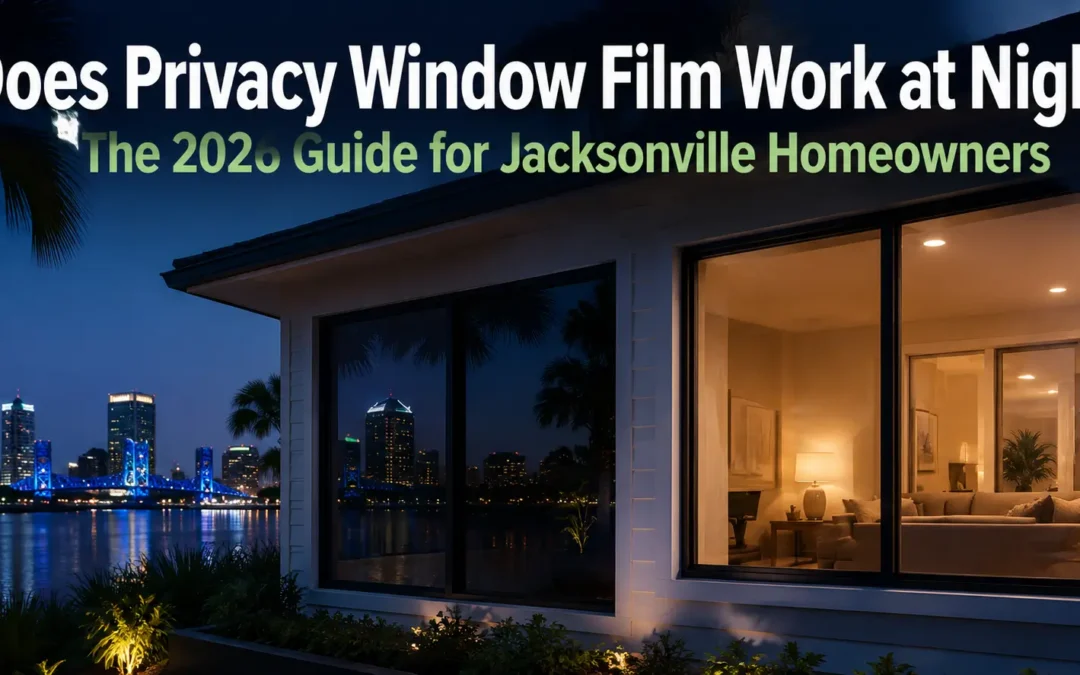
No — not fully. Reflective privacy window film relies on the outside being brighter than the inside to create its one-way mirror effect. Once the sun sets and your interior lights come on, that contrast reverses, and people outside can see in more easily than during the day. Frosted or etched film, dual-reflective film, and switchable smart film all hold up better after dark because they don’t depend on that light contrast.
Step outside a Riverside or Avondale bungalow after dinner, or walk the sidewalk in San Marco or near Jacksonville Beach on a warm evening, and you’ll notice something: this city doesn’t shut its curtains at sundown. Between beach walks, porch dinners, and evening dog walks, Jacksonville stays active well past dark — which is exactly when a lot of homeowners discover their “privacy window film” isn’t doing what they thought it was. If your living room windows feel like they’re on display once the lamps come on, you’re not imagining it, and you’re not alone. Here’s why it happens and which films actually solve it.
Why Does Privacy Window Film Stop Working After Dark?
Most privacy film sold for homes is a reflective film, and reflective film is really a light-contrast trick. During the day, sunlight outside is stronger than the light inside your home, so the film reflects that outdoor brightness back at anyone looking in — they see a mirror-like surface, while you can still see out clearly from the dimmer side.
Once the sun goes down and you flip on your indoor lights, the brighter room is now inside. The same physics that gave you a one-way mirror during the day works in reverse at night, and the film reflects less of the (now darker) outdoors while transmitting more of your well-lit interior outward. This isn’t a defect or a sign you bought the wrong brand — it’s simply how reflective film behaves whenever indoor light outweighs outdoor light.
What Types of Window Film Actually Give You Privacy Day and Night?

Reflective / Solar Films
The most common and most affordable category. Excellent daytime privacy and strong heat/glare control, but subject to the nighttime reversal described above.
Frosted or Etched Films
Rather than relying on reflection, these films use a translucent, textured surface that blurs the view from both sides, in any lighting. 3M’s decorative lines — including the FASARA® and Crystal glass finish collections, plus White Matte Translucent and Blackout film — fall into this category and are well suited to bathrooms, sidelites, home offices, and any street-facing room where you want privacy that doesn’t clock out at sunset.
Dual-Reflective Films
Reflective on the outward-facing side, less reflective on the inward-facing side. These balance daytime privacy with a somewhat softer nighttime look, though a brightly lit room can still overpower the effect after dark.
Switchable Smart Film (PDLC)
Electronic film that switches between a frosted, opaque state and a clear state at the flip of a switch, giving true around-the-clock control regardless of what’s happening with the lighting. It’s still a premium, emerging option for most residential budgets since it requires a low-voltage electrical connection, but the category is moving quickly: PDLC (polymer dispersed liquid crystal) technology now accounts for the large majority of smart-film installations because it switches opacity instantly, film thicknesses have dropped enough to make retrofits over existing glass realistic, and operating voltages have come down into safer, low ranges.
| Film Type | Daytime Privacy | Nighttime Privacy | Best For |
|---|---|---|---|
| Reflective / Solar Film | Excellent | Weak — reverses once interior lights are on | Sunny, street-facing windows where daytime glare and heat are the main issue |
| Dual-Reflective Film | Excellent | Fair — better than standard reflective, still light-dependent | Homes wanting a balance of daytime privacy and a softer nighttime look |
| Frosted / Etched Film (3M FASARA®, Crystal, White Matte, Blackout) | Excellent | Excellent — texture blurs the view regardless of light | Bathrooms, sidelites, street-level living rooms, home offices |
| Switchable Smart Film (PDLC) | Excellent | Excellent — instant opaque/clear control on demand | Home offices, media rooms, or feature windows where budget allows for electrical install |
Does 3M Make a Film Built Specifically for Nighttime Privacy?
For homeowners who want to keep more of their view while easing the nighttime mirror reversal, 3M’s Night Vision Series is engineered around lower interior reflectivity after dark, with published specs indicating it can reject a large share of solar heat while allowing a modest range of visible light through, depending on shade. It’s a helpful middle ground, but it works best as one part of a layered approach — paired with the nighttime habits below — rather than a stand-alone fix for a street-facing window.
How Much Does 24/7 Privacy Film Cost in 2026?
Reflective and dual-reflective films remain the most budget-friendly way to add privacy, with frosted and etched films typically landing in a similar-to-moderate range depending on coverage and pattern complexity. Switchable smart film sits well above both because of the electrical component and specialized materials — industry research points to a global smart-film market still in the low billions of dollars but growing at a low-double-digit rate annually, which is gradually pulling prices down as adoption spreads from commercial into residential use. For most Jacksonville homes, frosted or etched film on one or two priority windows is the most practical starting point before considering smart film.
5 Ways to Improve Nighttime Privacy Without Replacing Your Film

- Add curtains, blinds, or shutters for the evening. Keep your reflective film for daytime heat and glare control, and close a simple window covering once the lights go on — it closes the exact gap reflective film leaves after dark.
- Move lamps and bright fixtures away from the glass. The closer a bright light sits to the window, the more it lights up the film from the inside; pulling lighting toward the center of the room softens the contrast.
- Use warmer, dimmer bulbs near windows. Lower-intensity, warm-toned lighting reduces how much interior light spills outward and reflects off the glass.
- Add modest exterior lighting. A little more light on the outside of the window narrows the day/night contrast that causes the reversal in the first place.
- Reserve frosted or etched film for your highest-priority windows. If a full-home switch isn’t in the budget, prioritize the bathroom, primary bedroom, home office, or any street-facing room where nighttime privacy matters most.
Choosing the Right Film for Your Jacksonville Home
Jacksonville’s mix of coastal humidity, salt air near the beaches, and long, bright summers means a film has to hold up to more than just an evening walk-by — it has to be installed correctly to last. All Spec Sun Control has been a family-owned window tinting business in Jacksonville since 1983 and is a 3M Authorized Dealer, which means our installers are trained on 3M’s current film lineup, from solar and reflective films through frosted, etched, and privacy-focused options, and can help you match the right product to each room’s actual use rather than a one-size-fits-all recommendation.
If a specific window — a street-facing living room, a bathroom, a home office — is the one giving you trouble after dark, reach out for a free consultation. We’ll look at the window’s exposure, your lighting habits, and your budget, and recommend whichever category (or combination) actually solves it.
Frequently Asked Questions
Does privacy window film work at night?
Not the way most homeowners expect. Standard reflective privacy film depends on the outside being brighter than the inside. After dark, once interior lights are on, that contrast reverses and people outside can see in more easily. Frosted, etched, dual-reflective, and switchable smart films hold up far better after sunset because they don’t rely on that light contrast.
Why can people see into my house at night even with tinted windows?
Most tint sold for daytime privacy is a reflective film. Its one-way effect only works when it’s darker outside than inside. Turn on your lights at night and the brighter room becomes visible from the darker exterior, which is why the same window that looked private at 2 p.m. can feel exposed at 9 p.m.
What is the best window film for 24/7 privacy?
Frosted or etched film is the most cost-effective option that performs consistently day and night, since it blurs the view with texture instead of relying on reflection. Switchable smart (PDLC) film gives you the most control, letting you toggle between clear and fully opaque, but it costs more and needs an electrical connection.
Is frosted window film better than reflective film for nighttime privacy?
For rooms where nighttime privacy matters most, such as bathrooms, home offices, or street-facing living rooms, frosted or etched film generally outperforms reflective film after dark because its privacy doesn’t depend on which side of the glass is brighter.
How much does switchable smart film cost compared to standard privacy film?
Switchable smart film sits at the top of the price range because it requires an electrical hookup and specialized installation, while frosted, etched, and reflective films are considerably more affordable and need no wiring. Your installer can walk through current pricing for your specific windows.
Can I combine window film with blinds or curtains for full privacy?
Yes, and it’s one of the simplest fixes. Pairing daytime-focused reflective or solar film with blinds, curtains, or shutters you close in the evening covers the gap that reflective film leaves after dark, without the cost of replacing the film itself.
Does darker window film mean better nighttime privacy?
Not necessarily. Darkness affects heat and glare control more than nighttime privacy. A very dark reflective film can still be seen through from outside once interior lights are on, while a lighter frosted or etched film can hold its privacy consistently because it works by texture, not tint.
How long does professionally installed privacy window film last?
Quality film professionally installed on a home typically holds up for many years, though the exact lifespan depends on the product line, sun exposure, and installation quality. Ask your installer about the manufacturer warranty for the specific film you choose.