The best heat control window tint for Jacksonville homes and offices is a non-metallized ceramic or spectrally selective film, such as 3M Prestige Series. It can reject up to 97% of infrared heat and up to 60% of total solar energy without darkening windows or blocking WiFi.
For offices and commercial buildings, solar control films can cut cooling costs by up to 30%, according to the International Window Film Association. The right choice depends on window direction, building type, budget, and whether heat control, privacy, or security matters most.
All Spec Sun Control — Family-owned in Jacksonville since 1983 | 3M Authorized Dealer | Residential and Commercial Film Specialists | Serving Northeast Florida for 40+ years | Free in-home and on-site estimates
TL;DR — Key Takeaways:
- Ceramic and spectrally selective films give the strongest heat control for Jacksonville’s climate
- 3M Prestige Series rejects up to 97% of infrared heat and 99.9% of UV rays while staying nearly clear
- Residential window tinting usually costs $5-$20 per sq ft installed; most Jacksonville homes run $596-$840 total
- Office and commercial tinting lowers HVAC load, screen glare, and employee discomfort in a clear way
- Safety glazing film is not as strong as laminated glass, but it costs 60-80% less and installs in hours, not days
- Dyed film performs worst in Florida’s year-round UV and humidity — avoid it
- Jacksonville gets 233+ sunny days per year, which makes window film one of the fastest-payback energy upgrades available
Quick Facts: Heat Control Window Tinting in Jacksonville FL
| Metric | Data |
|---|---|
| Best film type for FL heat control | Ceramic / spectrally selective (non-metallized) |
| Infrared rejection — top tier | Up to 97% (3M Prestige Series) |
| Total solar heat reduction | Up to 60% (3M Prestige) |
| UV rays blocked | Up to 99.9% (premium films) |
| Cooling cost reduction | Up to 30% (IWFA) |
| Residential cost — Jacksonville | $596-$840 typical; $5-$20/sq ft |
| Commercial film warranty (3M) | Up to 15 years |
| Residential film warranty (3M) | Lifetime |
| DOE payback period | ~3 years (commercial applications) |
| Safety film vs. laminated glass cost | Film is 60-80% less expensive than glass replacement |
| ANSI standard met by quality safety film | ANSI Z97.1 / CPSC 16 CFR 1201 |
| Jacksonville sunny days per year | 233+ average |
What Is Heat Control Window Tint and How Does It Work?
Heat control window tint is a thin, multi-layered film applied directly to existing glass. It blocks specific parts of the solar spectrum — mainly infrared radiation and UV light — before they enter the building as heat and UV damage. It does not replace your windows; it upgrades their performance.
Understanding how heat enters through glass is the key to choosing the right film:
- Infrared radiation (IR) — invisible wavelengths that carry most solar heat. Standard glass passes most of this through freely. High-performance films block up to 97% of it.
- UV — causes fading in flooring, furniture, and artwork. Quality films block up to 99.9% of UV while barely changing visible light.
- Visible light (VLT) — the Visible Light Transmission percentage. This controls how bright or dark the room looks. Heat control and brightness are separate — a nearly clear film can still block most heat.
- SHGC (Solar Heat Gain Coefficient) — the overall measure of how much solar energy passes through glass as heat. A lower SHGC means less heat gain. Quality film lowers your glass’s SHGC without the cost of full window replacement.
In Jacksonville, where air conditioning runs for eight to ten months of the year, lower solar heat gain through windows has a direct effect on monthly electric bills. According to the U.S. Department of Energy, windows can account for up to 30% of residential heating and cooling energy loss — and solar heat gain through untreated glass is a major issue in Florida’s climate.
Which Window Film Type Provides the Best Heat Control for Jacksonville Homes?
Not all window tint is made for heat control. The film type — not how dark it looks — determines how much heat is actually blocked. Here is a direct comparison of the major film types available in Jacksonville in 2026.
| Film Type | IR Heat Rejection | UV Blocked | Visible Light (VLT) | WiFi Safe? | FL Durability | Typical Cost/Sq Ft |
|---|---|---|---|---|---|---|
| Dyed Film | ~20-35% | Moderate | Low (dark) | Yes | Poor — fades and bubbles fastest | $3-$6 |
| Carbon Film | ~50-60% | Good | Moderate | Yes | Good — resists fading | $6-$9 |
| Metalized Film | ~55-70% | Good | Reflective look | No — blocks signals | Can corrode near coast | $7-$11 |
| Ceramic Film | ~65-80% | Up to 99% | High — stays bright | Yes | Excellent | $8-$14 |
| 3M Prestige (Spectrally Selective) | Up to 97% | Up to 99.9% | High — nearly clear | Yes | Excellent — non-metallized | $12-$20 |
| 3M Sun Control Series | Up to 78% | Up to 99% | Various options | Varies by variant | Excellent | $8-$16 |
What this table means for Jacksonville homeowners:
- Dyed film — Avoid it for heat control. It absorbs heat into the glass instead of reflecting it, and it ages fast in Florida’s strong UV. Purple tint, bubbling, and adhesive failure within two to four years are common.
- Carbon film — A better choice than dyed film. It is a good mid-range option for rooms with moderate sun exposure where budget matters.
- Ceramic film — The best value for heat-focused installs. It gives strong heat and UV rejection, no signal problems, and solid durability in Florida humidity.
- 3M Prestige / Spectrally Selective — Top heat performance. Non-metallized construction means no coastal corrosion risk and no WiFi interference — a smart fit for smart homes and HOA properties that need a low-glare look.
What Makes 3M Prestige and 3M Solar Window Film Different From Standard Tint?
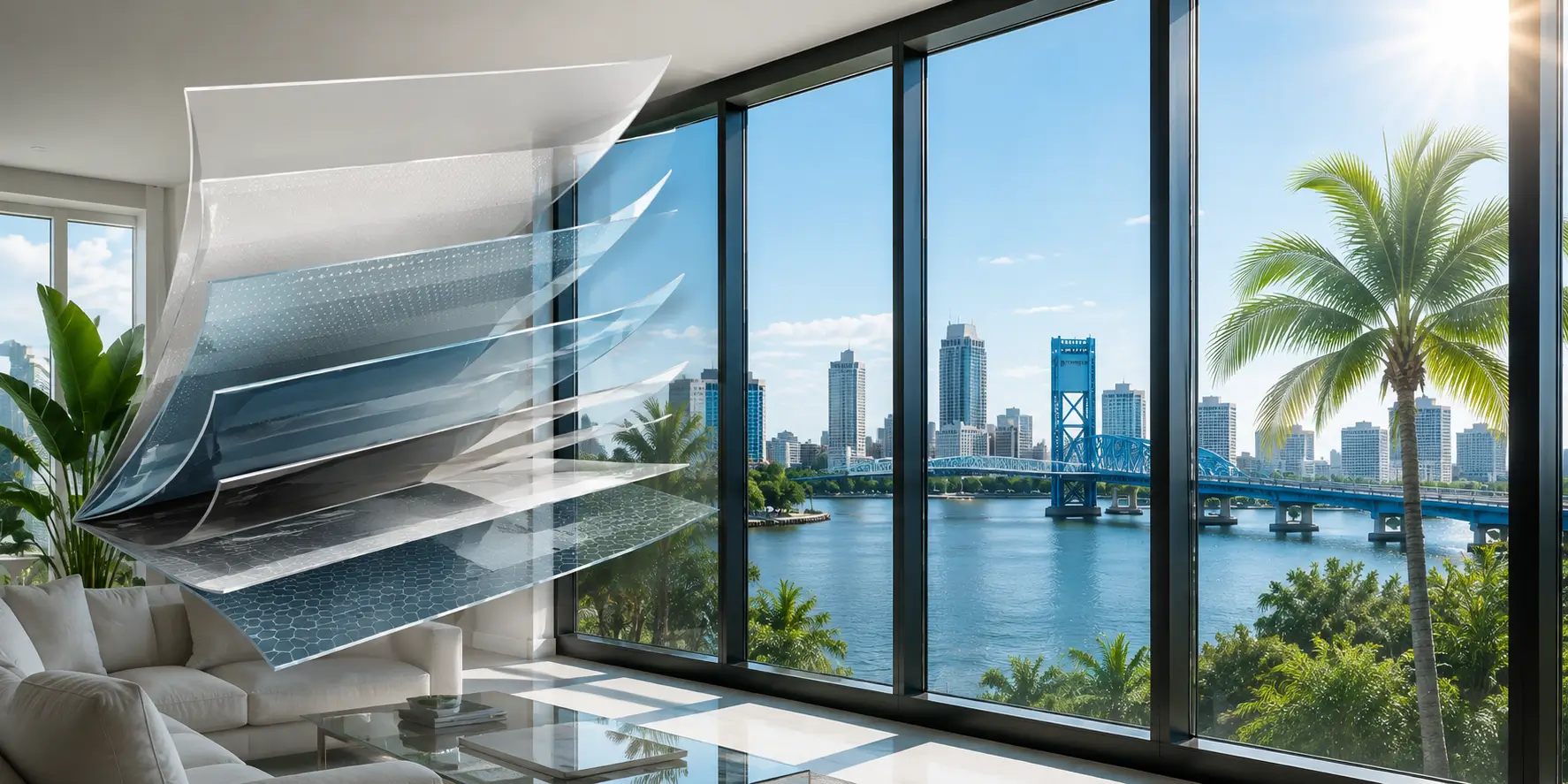
3M solar window film — including the Prestige Series and Sun Control Series — uses multi-layer optical film technology built from nano-scale layers rather than metallic particles. That is what sets it apart from standard tinted or metalized films, and why it works so well in Florida.
3M Prestige Series — manufacturer-published performance data:
- Infrared rejection: up to 97%
- Total solar heat reduction: up to 60%
- UV rejection: up to 99.9%
- Visible light transmission options: 20% to 90% VLT — homeowners choose how bright the room stays
- Interior shine: low — no mirror effect from inside
- Exterior shine: low — keeps the natural look of the window from the street
- Metallized: No — non-metallized build; will not corrode in coastal salt air or interfere with electronic signals
- Residential warranty: Lifetime
Why this matters specifically for Jacksonville:
- Jacksonville’s coastal location means salt air is a real long-term issue for metalized films — non-metallized ceramic and Prestige-tier films remove that risk
- HOA communities across Jacksonville often want a low-glare look — 3M Prestige meets most HOA appearance rules
- Historic districts and older neighborhoods often have strict window appearance rules — low-glare, non-metallized film is the safest fit
- Smart homes with many WiFi devices, mesh networks, and security cameras need signal-safe film — non-metallized films do not affect wireless signals
All Spec Sun Control is a 3M Authorized Dealer, which means every 3M film install includes real manufacturer paperwork, warranty support through 3M, and installation standards verified by the maker.
How Much Does Residential Window Tinting Cost in Jacksonville in 2026?
Cost is usually the first question Jacksonville homeowners ask — and the honest answer is that it varies by film type and window count. Here is a full breakdown based on 2026 local market data.
| Film Type | Cost Per Sq Ft (Installed) | Typical Home Total | Heat Rejection | Best For |
|---|---|---|---|---|
| Standard / Non-Reflective | $3-$6 | $300-$500 | ~20-35% | Basic UV protection and privacy |
| Carbon Film | $6-$9 | $450-$700 | ~50-60% | Mid-range heat + no shine |
| Ceramic Film | $8-$14 | $600-$1,000 | ~65-80% | Best value for heat control |
| 3M Prestige / Spectrally Selective | $12-$20 | $900-$1,700+ | Up to 97% IR | Maximum performance + clear look |
| Security Film | $8-$16 | $600-$1,200 | Moderate | Storm and impact protection |
| Decorative / Frosted Film | $6-$13 | $400-$900 | Low to moderate | Bathrooms, entryways, privacy |
Typical total for a Jacksonville home: Based on local project data, most homeowners pay between $596 and $840 for a standard install. Larger homes, premium film choices, or hard-to-reach windows like skylights and upper floors can raise the price.
What affects the final price:
- Number of windows and total square footage
- Film type selected — the biggest single cost factor
- Window access — upper floors and skylights add labor time
- Removal of old or failed film before new install
- Single-pane vs. double-pane glass — fit check needed for some films
- Window shape — arched, angled, or non-standard shapes need custom cutting
Is window tinting worth the cost in Jacksonville? The U.S. Department of Energy says window film is one of the fastest-payback energy conservation upgrades available, with a typical commercial payback period of about three years. For homes in Jacksonville’s long cooling season — where AC runs for most of the year — the same savings pattern can be realistic for high-exposure windows.
Why Are Jacksonville Businesses Choosing Office Window Tinting in 2026?
Office window tinting in Jacksonville has moved from a nice upgrade to a practical cost decision. For businesses with south- or west-facing glass, untreated windows push up utility bills, add employee discomfort, and speed up wear on merchandise and assets.
Why Jacksonville offices and commercial buildings are installing window film:
- Energy cost reduction — High-quality commercial solar films reject 50% to 80% of solar heat gain. About one-third of a commercial building’s cooling cost comes from solar heat through windows, per 3M’s building data. Cutting that load lowers monthly bills.
- Employee productivity — Screen glare is one of the most common workplace comfort issues. Film removes hot spots near windows and reduces glare without forcing teams to use blinds that block natural light and the view.
- Customer and patient comfort — Retail stores, restaurants, medical waiting areas, and service lobbies with direct sun are more comfortable after install — which can improve dwell time and the customer or patient experience.
- Asset and merchandise protection — UV-blocking commercial film protects floors, furniture, merchandise, and equipment from sun fade and damage — a direct financial gain for retailers and showrooms.
- HVAC load reduction — When windows reject more heat, HVAC systems cycle less often. That lowers wear, extends equipment life, and reduces maintenance costs over time.
- Privacy and branding — Frosted, etched-look, and branded decorative films can be used on conference room glass, storefronts, and interior partitions to create clean, privacy-friendly spaces.
What Types of Commercial Window Film Are Available for Jacksonville Offices and Buildings?
| Film Type | Primary Purpose | Heat Rejection | Common Applications | Warranty |
|---|---|---|---|---|
| Solar Control / Energy Film | Heat and glare reduction | 50-80% | Offices, retail, medical, restaurants | Up to 15 years (3M) |
| 3M Prestige Commercial | Maximum performance, clear look | Up to 97% IR | High-rise offices, HOA buildings | Up to 15 years (3M) |
| Security / Safety Film | Glass reinforcement | Moderate | Ground-floor entry, storefronts, schools | Varies by product |
| Decorative / Frosted Film | Privacy and branding | Low to moderate | Conference rooms, glass partitions | Varies by product |
| Reflective / One-Way Film | Daytime privacy + heat | High | Street-facing windows, waiting areas | Varies by product |
| Anti-Graffiti Film | Surface scratch protection | Minimal | Ground-floor glass, elevators | Varies by product |
Unlike structural building upgrades, commercial window film usually does not need permits in most Jacksonville applications. That makes install faster and less disruptive to business operations. Most commercial jobs are finished in one to three days, depending on building size and window count.
How Does Energy Saving Window Film Actually Reduce Electric Bills in Jacksonville?
Energy saving window film lowers your building’s Solar Heat Gain Coefficient (SHGC) — the technical measure of how much solar energy passes through glass as heat. Here is how the savings work:
- Untreated single-pane glass has an SHGC close to 1.0 — almost all solar heat enters the building
- Quality energy saving window film lowers the effective SHGC of that glass and blocks more heat before it enters
- Less heat enters the room, so the thermostat stays lower
- The AC cycles less often and uses less electricity
- Over months and years, the effect is substantial in Jacksonville’s long cooling season
Energy performance — verified figures from trusted sources:
- Up to 30% reduction in cooling costs in high-temperature regions — International Window Film Association
- Up to 30% of residential heating and cooling energy loss comes through windows — U.S. Department of Energy
- About 3 years typical payback period — cited by the DOE as one of the fastest-payback energy conservation upgrades
- Lifetime residential warranty on premium non-metallized films — so the investment can keep paying back for decades
For context: replacing windows with new high-efficiency glass can cost 10 to 15 times more than applying film to the existing glass — and the energy results are often very close. Window film upgrades what you already have without structural changes, permits, or long install times.
Is Safety Glazing Film as Strong as Laminated Glass?
No — laminated glass is generally stronger in terms of forced-entry resistance. However, safety glazing film meets recognized safety standards (ANSI Z97.1 / CPSC 16 CFR 1201), costs 60-80% less than laminated glass replacement, and installs in hours on your existing windows. For most Jacksonville homeowners and businesses, film is the practical and cost-effective path to better glass safety.
This is one of the most common but least clearly answered questions in the window film market. Here is a simple side-by-side view.
| Factor | Safety Glazing Film | Laminated Glass |
|---|---|---|
| Structural strength | Stronger than untreated glass; holds shards together on impact | Superior — interlayer is bonded inside the glass |
| Forced entry resistance | Slows entry; delays rather than stops a determined intruder | Higher resistance; more robust under sustained attack |
| Storm / hurricane performance | Holds shattered glass in place; reduces flying glass risk | Excellent — standard in Florida hurricane zones |
| Install method | Applied to existing glass — retrofit; no frame removal | Full window replacement — frames removed, new glass installed |
| Install time | Hours — most homes done in one day | Days to weeks depending on job size |
| Cost comparison | $8-$16 per sq ft installed | $25-$100+ per sq ft |
| Business disruption | Minimal — business can stay open | High — window removal and replacement needed |
| Permits required | Usually none for residential film | Usually required — structural replacement |
| Safety standards met | ANSI Z97.1 / CPSC 16 CFR 1201 (quality films) | Various building code and impact standards |
| UV protection | Up to 99.9% (quality safety + solar combo films) | Moderate — depends on the glass spec |
| Added heat control | Yes — solar-safety combo films are available | Limited unless it is specially specified |
| Reversible / upgradeable | Yes — film can be replaced or upgraded | No — permanent structural change |
Solar vs. security film — what is the difference?
- Solar control film — made mainly to block infrared heat and UV radiation. Thin (usually 2-4 mil). It offers little impact resistance but strong energy performance.
- Security film — made mainly to hold shattered glass together on impact. Thick (usually 8-14 mil, and sometimes up to 21 mil for blast-rated uses). It offers very little heat control unless it is paired with a solar layer.
- Combination solar-security film — available from 3M and other makers. It gives heat rejection, UV blocking, and glass retention on impact in one film. This is often the most practical choice for Jacksonville homeowners who want both energy savings and storm or security protection.
When to choose film over laminated glass replacement:
- Budget matters — film usually costs 60-80% less
- You want less disruption — a day instead of days or weeks
- You need heat control plus safety — combo films do both
- Your windows are still sound — film works on glass that is not damaged
When laminated glass makes more sense:
- The existing glass is damaged, fogged, or has seal failure and needs replacement anyway
- You are in a Florida hurricane impact zone that requires certified impact glass
- Forced-entry prevention — not just injury reduction — is the main goal in a high-risk commercial job
Which Windows in a Jacksonville Home or Office Should Be Tinted First?
Window direction controls how much solar heat enters and when. The U.S. Department of Energy gives this guidance for ranking window film in hot climates:
- West-facing windows — highest priority: They get the strongest afternoon sun, when outdoor temperatures peak. West-facing rooms in Jacksonville often feel 10-15 degrees warmer than the rest of the house from mid-afternoon onward.
- South-facing windows — second priority: They get direct sun through most of the day. In Florida, this is a major source of year-round solar heat gain.
- East-facing windows — third priority: They get strong morning sun, which is most noticeable in kitchens, breakfast areas, and east-facing bedrooms.
- North-facing windows — lowest heat priority: They get the least direct solar heat gain. UV protection for furniture and flooring still matters, but heat control is less critical.
For commercial buildings and offices, west-facing glass in conference rooms and open-plan work areas is usually the top priority. Those spaces can become hard to use because of glare and heat in the late afternoon, which affects both productivity and HVAC costs.
What Are the Most Common Window Tinting Mistakes Jacksonville Homeowners Make?
- Choosing film based on darkness alone. TSER (Total Solar Energy Rejected) and IR rejection ratings tell you how well a film controls heat — not how dark it looks. A clear ceramic film can beat a dark dyed film on every heat metric.
- Using dyed film in Florida. Dyed films absorb heat into the glass instead of reflecting it, and they break down faster in high-UV weather. Purple tint, bubbling, and adhesive failure within two to four years are common.
- DIY install in Florida’s humidity. Film adhesion needs controlled conditions. Jacksonville’s humidity makes proper bonding harder — bubbling, peeling edges, and trapped moisture are more common with DIY kits.
- Not checking warranty paperwork. Real 3M and ceramic films include written manufacturer warranties. Off-brand or fake film sold at a steep discount usually does not, and there is no maker support when it fails early.
- Installing film on damaged or fogged glass. Film over glass with seal failure, condensation between panes, or other damage will not stick well and will not perform as promised. A site review should find these issues before film is chosen.
- Ignoring HOA or local rules. Some films — especially very reflective or mirrored options — may not meet community appearance rules. Low-glare, non-metallized films are usually the safest choice for HOA-governed properties.
Why Jacksonville Homeowners and Businesses Trust All Spec Sun Control
- 40+ years of Jacksonville experience — Family-owned and operating since 1983, serving residential and commercial clients across Northeast Florida. Window film is not a side service — it is the whole business.
- 3M Authorized Dealer status — Every 3M film installed by All Spec comes with real manufacturer paperwork, verified install standards, and warranty support directly through 3M. That is not available from non-authorized dealers.
- Residential and commercial expertise — From single-room home projects to multi-story commercial buildings, All Spec handles work across Jacksonville, the Beaches, Mandarin, Fleming Island, and nearby communities.
- Lifetime residential warranty — Premium non-metallized films installed by All Spec come with manufacturer-backed lifetime residential warranties — so the investment can pay back for decades.
- Free in-home and on-site estimates — Every job starts with a no-obligation site review, including glass type, window direction, and film recommendation before any commitment is made.
- Honest film recommendations — Not every home needs the most expensive film. All Spec gives the right film for the job — not just the highest-margin option.
Frequently Asked Questions — Window Tinting in Jacksonville FL
What is the best heat control window tint for a Jacksonville home?
Ceramic and spectrally selective non-metallized films give the strongest heat control for Jacksonville’s climate. 3M Prestige Series rejects up to 97% of infrared heat and 60% of total solar heat while staying nearly clear — so it is the top choice for homeowners who want maximum heat reduction without a dark or reflective look. For a more budget-friendly option, ceramic film in the 30-50% VLT range gives strong heat control at a lower price.
How much does residential window tinting cost in Jacksonville FL?
Most Jacksonville homeowners pay between $596 and $840 for a standard home install, based on local project data. Cost per square foot ranges from $3-$6 for basic dyed film to $12-$20 for 3M Prestige and premium ceramic options. The biggest cost factor is film type — higher-performance film costs more up front but usually gives better energy savings, longer life, and a stronger warranty.
Does office window tinting make a noticeable difference in Jacksonville?
Yes — especially for west- and south-facing offices that get strong afternoon sun. Screen glare, hot spots near windows, and uneven HVAC temperatures are some of the most common complaints in glass-heavy Jacksonville offices. Professional solar control film reduces those issues in a clear way: rooms that felt too hot by 2 pm often stay more comfortable through the day after install.
Is safety glazing film as strong as laminated glass?
No — laminated glass is usually more structurally robust for forced entry because the interlayer is part of the glass itself. However, quality safety glazing film meets ANSI Z97.1 safety standards, holds shattered glass together on impact, adds real storm protection, and costs 60-80% less than laminated glass replacement. For most Jacksonville homeowners and businesses that want better safety without full window replacement, film is the practical choice.
What is the difference between solar film and security film?
Solar control film is made to block infrared heat and UV radiation — it is thin (usually 2-4 mil) and focuses on energy performance. Security film is thick (8-14 mil or more) and made to hold broken glass together on impact — on its own, it gives very little heat control. Combination solar-security films from 3M give both functions in one layer, which is often the best option for Jacksonville homeowners who want heat reduction and storm protection.
How long does window film last in Florida’s climate?
Premium non-metallized ceramic and spectrally selective films can last 20+ years when installed by a pro, and they come with lifetime residential warranties. Dyed films usually need replacement within two to four years in Florida because of year-round UV exposure. Florida humidity also makes professional install important — proper edge sealing helps the film last longer than DIY kits used in damp conditions.
Will commercial window tinting lower my Jacksonville business’s electric bill?
Yes, in a measurable way. Solar heat gain through windows makes up about one-third of commercial cooling costs, according to 3M’s building data. High-quality commercial films that reject 50-80% of that heat cut HVAC cycling. The International Window Film Association cites up to 30% lower cooling costs in high-heat climates, with a DOE-cited payback period of about three years.
Does window tinting affect WiFi or cell phone signals?
Only metalized or metal-containing films create that risk. Non-metallized films — including all ceramic and spectrally selective options like 3M Prestige — have no effect on WiFi, cellular, GPS, or any other wireless signal. For smart homes, offices with wireless networks, or commercial buildings with cell-based systems, non-metallized film is the best choice.
What is the difference between energy saving window film and standard window tint?
Standard window tint mainly reduces visible light — it makes the glass darker but may block very little heat. Energy saving window film is made to target the infrared wavelengths that carry heat, not just the visible light that makes the room look darker. A high-performance energy saving film can block most solar heat while keeping the room bright, which basic dark tint cannot do.
How do I choose between the different window film options for my Jacksonville home?
Start with the direction of your hottest rooms — west and south-facing rooms need the strongest heat rejection. Then match the film to your goal: 3M Prestige for top performance with a clear look, ceramic film for strong performance and better value, security film if storm protection is the main concern, or decorative film for privacy in bathrooms and entryways. A free in-home estimate from All Spec Sun Control includes this review at no cost before you commit.
Ready to Control the Heat, Lower Your Bills, and Protect Your Property?
All Spec Sun Control has been Jacksonville’s trusted window film specialist since 1983. As a 3M Authorized Dealer, every install includes manufacturer-backed warranty coverage and 40+ years of local expertise. Do you need heat control, energy savings, or safety film? Get started with a free estimate.
Q&A
Question: Is the darkest window tint always the best choice for blocking heat in Jacksonville?
Short answer: No. Heat control depends more on IR rejection, TSER, and SHGC performance than on how dark the film looks. A high-quality ceramic or spectrally selective film can block much more solar heat than a dark dyed film while still keeping the room bright. That matters in Jacksonville, where many homeowners want heat reduction without making rooms feel dark or changing the outside look of the home.
Question: Which windows should be tinted first if the budget does not allow treating the whole home or office?
Short answer: Start with west-facing windows, then south-facing windows. West-facing glass gets the strongest afternoon sun, when Jacksonville temperatures are usually highest, and those rooms often feel the most uncomfortable. East-facing windows come next, while north-facing windows usually need film more for UV protection than for heat control.
Question: Why are non-metallized films recommended for many Jacksonville properties?
Short answer: Non-metallized films, including ceramic and 3M Prestige Series films, fit Jacksonville well because they do not corrode in coastal salt air and do not interfere with WiFi, cellular, GPS, security systems, or smart-home devices. They also tend to have a lower-glare look, which can help them meet HOA or historic district appearance rules while still giving strong heat and UV protection.
Question: Can window film be installed on any existing window?
Short answer: Not always. Window film works best on glass that is in good shape. Windows with seal failure, fogging between panes, cracks, damaged glass, or other defects should be checked first because those problems can affect adhesion and performance. A pro site review helps confirm glass fit, window condition, and the best film for each area.
Question: Does safety film replace the need for laminated or hurricane impact glass?
Short answer: No. Safety film helps hold shattered glass together, but laminated or certified impact glass is usually stronger and may be required in some hurricane impact zones or code-based projects. Safety film is often the practical retrofit when the existing glass is sound and the goal is better safety, less flying-glass risk, lower cost, and less disruption.