The best heat control window tint for Jacksonville homes and offices is a non-metallized ceramic or spectrally selective film — such as 3M Prestige Series — which rejects up to 97% of infrared heat and up to 60% of total solar energy without darkening windows or blocking WiFi signals. For offices and commercial buildings, solar control films can reduce cooling costs by up to 30%, according to the International Window Film Association. The right film depends on your window orientation, building type, budget, and whether heat control, privacy, or security is the primary need.
All Spec Sun Control — Family-owned in Jacksonville since 1983 | 3M Authorized Dealer | Residential and Commercial Film Specialists | Serving Northeast Florida for 40+ years | Free in-home and on-site estimates
TL;DR — Key Takeaways:
- Ceramic and spectrally selective films deliver the strongest heat control for Jacksonville’s climate
- 3M Prestige Series rejects up to 97% of infrared heat and 99.9% of UV rays while remaining nearly clear
- Residential window tinting typically costs $5–$20 per sq ft installed; most Jacksonville homes run $596–$840 total
- Office and commercial tinting reduces HVAC load, screen glare, and employee discomfort — measurably
- Safety glazing film is not as structurally strong as laminated glass, but costs 60–80% less and installs in hours, not days
- Dyed film performs worst in Florida’s year-round UV and humidity — avoid it
- Jacksonville averages 233+ sunny days per year, making window film one of the fastest-payback energy upgrades available
Quick Facts: Heat Control Window Tinting in Jacksonville FL
| Metric | Data |
|---|---|
| Best film type for FL heat control | Ceramic / spectrally selective (non-metallized) |
| Infrared rejection — top tier | Up to 97% (3M Prestige Series) |
| Total solar heat reduction | Up to 60% (3M Prestige) |
| UV rays blocked | Up to 99.9% (premium films) |
| Cooling cost reduction | Up to 30% (IWFA) |
| Residential cost — Jacksonville | $596–$840 typical; $5–$20/sq ft |
| Commercial film warranty (3M) | Up to 15 years |
| Residential film warranty (3M) | Lifetime |
| DOE payback period | ~3 years (commercial applications) |
| Safety film vs. laminated glass cost | Film is 60–80% less expensive than glass replacement |
| ANSI standard met by quality safety film | ANSI Z97.1 / CPSC 16 CFR 1201 |
| Jacksonville sunny days per year | 233+ average |
What Is Heat Control Window Tint and How Does It Work?
Heat control window tint is a thin, multi-layered film applied directly to existing glass that blocks specific wavelengths of the solar spectrum — primarily infrared radiation and ultraviolet light — before they enter the building as heat and UV damage. It does not replace your windows; it upgrades their performance.
Understanding how heat actually enters a building through glass is the key to choosing the right film:
- Infrared radiation (IR) — invisible wavelengths that carry the majority of solar heat. Standard glass passes most of this through freely. High-performance films block up to 97% of it.
- Ultraviolet radiation (UV) — causes fading in flooring, furniture, and artwork. Quality films block up to 99.9% of UV while barely affecting visible light.
- Visible light (VLT) — measured as Visible Light Transmission percentage. This is what controls how bright or dark the room appears. Heat control and brightness are independent — a nearly clear film can still block most of the heat.
- SHGC (Solar Heat Gain Coefficient) — the overall measure of how much solar energy passes through glass as heat. A lower SHGC means less heat gain. Quality film significantly lowers your existing glass’s SHGC without the cost of full window replacement.
In Jacksonville, where air conditioning runs for eight to ten months of the year, reducing solar heat gain through windows has a direct and measurable impact on monthly electricity bills. According to the U.S. Department of Energy, windows are responsible for up to 30% of residential heating and cooling energy loss — and solar heat gain through untreated glass is the dominant factor in Florida’s climate.
Which Window Film Type Provides the Best Heat Control for Jacksonville Homes?
Not all window tint is designed for heat control. The type of film — not how dark it looks — determines how much heat is actually blocked. Here is a direct comparison of every major film type available in Jacksonville in 2026.
| Film Type | IR Heat Rejection | UV Blocked | Visible Light (VLT) | WiFi Safe? | FL Durability | Typical Cost/Sq Ft |
|---|---|---|---|---|---|---|
| Dyed Film | ~20–35% | Moderate | Low (dark) | Yes | Poor — fades and bubbles fastest | $3–$6 |
| Carbon Film | ~50–60% | Good | Moderate | Yes | Good — resists fading | $6–$9 |
| Metalized Film | ~55–70% | Good | Reflective look | No — blocks signals | Can corrode near coast | $7–$11 |
| Ceramic Film | ~65–80% | Up to 99% | High — stays bright | Yes | Excellent | $8–$14 |
| 3M Prestige (Spectrally Selective) | Up to 97% | Up to 99.9% | High — nearly clear | Yes | Excellent — non-metallized | $12–$20 |
| 3M Sun Control Series | Up to 78% | Up to 99% | Various options | Varies by variant | Excellent | $8–$16 |
What this table means for Jacksonville homeowners:
- Dyed film — Avoid for heat control. It absorbs rather than reflects heat, meaning the glass itself heats up. In Florida’s intense UV, dyed film fades, bubbles, and turns purple significantly faster than in cooler climates.
- Carbon film — A meaningful upgrade from dyed film. Good mid-range choice for rooms with moderate sun exposure where budget is a priority.
- Ceramic film — The best value for heat-focused installations. Strong heat and UV rejection, no signal interference, and excellent durability in Florida’s humidity.
- 3M Prestige / Spectrally Selective — Maximum heat performance. Non-metallized construction means no coastal corrosion risk and no WiFi interference — particularly important for smart homes and HOA properties where a low-reflectivity look is required.
What Makes 3M Prestige and 3M Solar Window Film Different From Standard Tint?
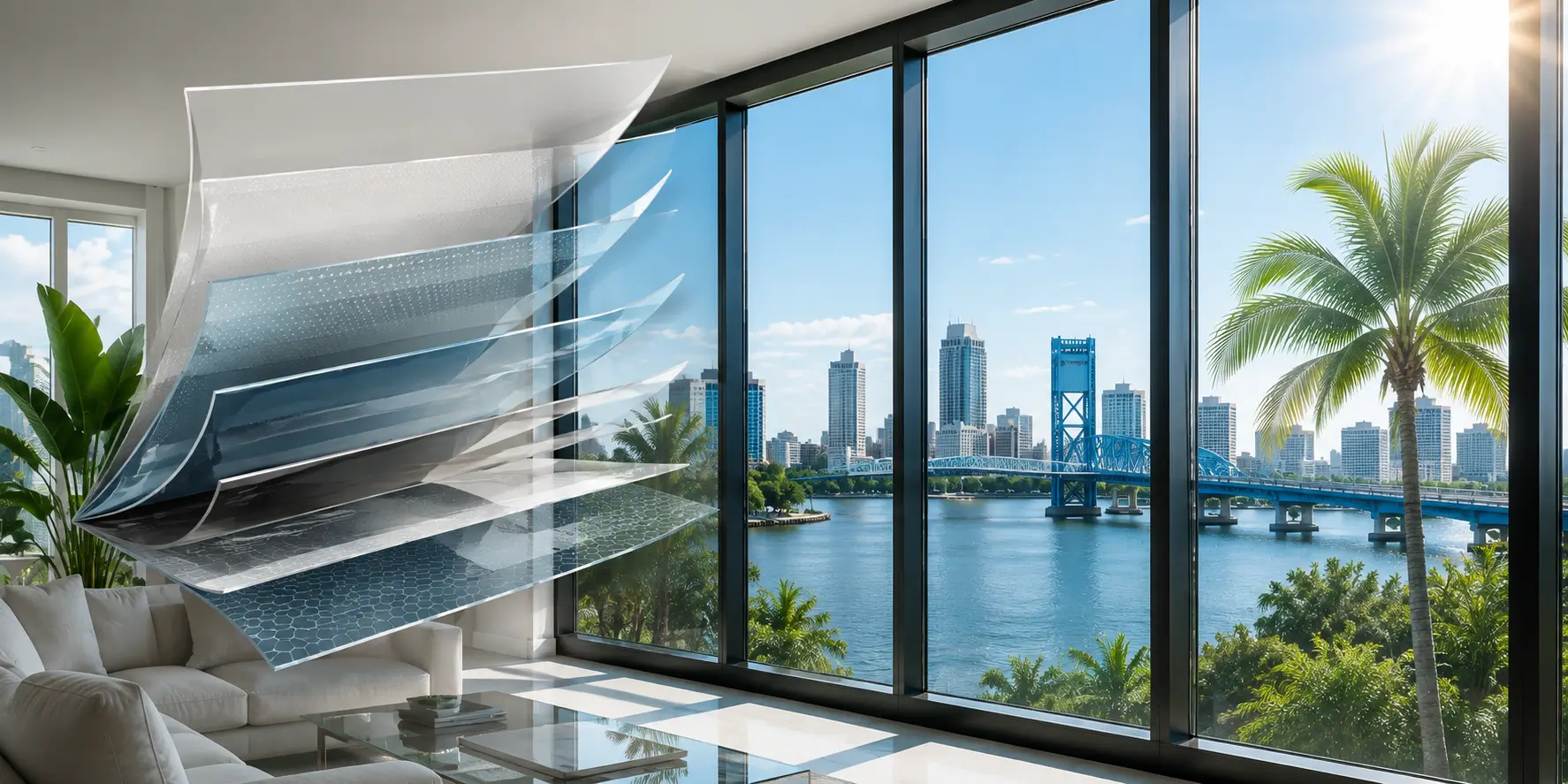
3M solar window film — including the Prestige Series and Sun Control Series — uses multi-layer optical film (MOF) technology built from nano-scale layers rather than metallic particles. This is what separates it from conventional tinted or metalized films, and why it performs consistently better in Florida’s conditions.
3M Prestige Series — manufacturer-published performance data:
- Infrared rejection: up to 97%
- Total solar heat reduction: up to 60%
- UV rejection: up to 99.9%
- Visible light transmission options: 20% to 90% VLT — homeowners choose how bright the room stays
- Interior reflectivity: low — no mirror effect from inside
- Exterior reflectivity: low — maintains the natural look of the window from the street
- Metallized: No — non-metallized construction; won’t corrode in coastal salt air or interfere with any electronic signals
- Residential warranty: Lifetime
Why this matters specifically for Jacksonville:
- Jacksonville’s coastal proximity means salt air is a real long-term concern for metallized films — non-metallized ceramic and Prestige-tier films eliminate this risk entirely
- HOA communities throughout Jacksonville and surrounding areas typically require low-reflectivity film — 3M Prestige passes most HOA appearance standards
- Historic districts and older neighborhoods often have specific window appearance rules — low-reflectivity non-metallized film is the safest compliance choice
- Smart homes with multiple WiFi devices, mesh networks, and security cameras need signal-safe film — non-metallized films have zero impact on any wireless signal
All Spec Sun Control is a 3M Authorized Dealer, meaning every 3M film installation comes with authentic manufacturer documentation, warranty support directly through 3M, and installation standards verified by the manufacturer.
How Much Does Residential Window Tinting Cost in Jacksonville in 2026?
Cost is consistently the first question Jacksonville homeowners ask — and the honest answer is that it varies meaningfully by film type and window count. Here is a complete breakdown based on 2026 local market data.
| Film Type | Cost Per Sq Ft (Installed) | Typical Home Total | Heat Rejection | Best For |
|---|---|---|---|---|
| Standard / Non-Reflective | $3–$6 | $300–$500 | ~20–35% | Basic UV protection and privacy |
| Carbon Film | $6–$9 | $450–$700 | ~50–60% | Mid-range heat + no reflectivity |
| Ceramic Film | $8–$14 | $600–$1,000 | ~65–80% | Best value for heat control |
| 3M Prestige / Spectrally Selective | $12–$20 | $900–$1,700+ | Up to 97% IR | Maximum performance + clear look |
| Security Film | $8–$16 | $600–$1,200 | Moderate | Storm and impact protection |
| Decorative / Frosted Film | $6–$13 | $400–$900 | Low to moderate | Bathrooms, entryways, privacy |
Typical total for a Jacksonville home: Based on aggregated local project data, most homeowners pay between $596 and $840 for a standard installation. Larger homes, premium film selections, or complex window configurations (skylights, arched windows, upper-floor access) move costs higher.
What affects the final price:
- Number of windows and total square footage
- Film type selected — the biggest single cost variable
- Window accessibility — upper floors and skylights add labor time
- Removal of old or failed film before new installation
- Single-pane vs. double-pane glass — compatibility check required for some films
- Window shape — arched, angled, or non-standard shapes require custom cutting
Is window tinting worth the cost in Jacksonville? The U.S. Department of Energy identifies window film as one of the fastest-payback energy conservation technologies available, with a typical commercial payback period of approximately three years. For residential applications in Jacksonville’s long cooling season — where air conditioning runs for most of the year — comparable savings timelines are realistic for homeowners treating high-exposure windows.
Why Are Jacksonville Businesses Choosing Office Window Tinting in 2026?
Office window tinting in Jacksonville has moved from an optional comfort upgrade to a practical operating cost decision. For businesses with significant south- or west-facing glass, untreated windows contribute directly to higher utility bills, employee discomfort, and merchandise or asset degradation.
Why Jacksonville offices and commercial buildings are installing window film:
- Energy cost reduction — High-quality commercial solar films reject between 50% and 80% of solar heat gain. Approximately one-third of a commercial building’s cooling costs comes from solar heat through windows, per 3M’s building data. Reducing that load directly lowers monthly utility bills.
- Employee productivity — Screen glare is one of the most commonly reported workplace comfort issues. Film eliminates hot spots near windows and reduces glare without requiring blinds that block natural light and the view.
- Customer and patient comfort — Retail stores, restaurants, medical waiting areas, and service lobbies with direct sun exposure are noticeably more comfortable after installation — improving dwell time and patient or customer experience.
- Asset and merchandise protection — UV-blocking commercial film protects flooring, furniture, displayed merchandise, and equipment from sun-related fading and degradation — a direct financial consideration for retailers and showrooms.
- HVAC load reduction — When windows reject more heat, HVAC systems cycle less frequently, reducing wear, extending equipment lifespan, and lowering maintenance costs over time.
- Privacy and branding — Frosted, etched-look, and branded decorative films can be applied to conference room glass, storefronts, and interior partitions to create professional, privacy-appropriate spaces.
What Types of Commercial Window Film Are Available for Jacksonville Offices and Buildings?
| Film Type | Primary Purpose | Heat Rejection | Common Applications | Warranty |
|---|---|---|---|---|
| Solar Control / Energy Film | Heat and glare reduction | 50–80% | Offices, retail, medical, restaurants | Up to 15 years (3M) |
| 3M Prestige Commercial | Maximum performance, clear look | Up to 97% IR | High-rise offices, HOA buildings | Up to 15 years (3M) |
| Security / Safety Film | Glass reinforcement | Moderate | Ground-floor entry, storefront, schools | Varies by product |
| Decorative / Frosted Film | Privacy and branding | Low to moderate | Conference rooms, glass partitions | Varies by product |
| Reflective / One-Way Film | Daytime privacy + heat | High | Street-facing windows, waiting areas | Varies by product |
| Anti-Graffiti Film | Surface scratch protection | Minimal | Ground-floor glass, elevators | Varies by product |
Unlike structural building upgrades, commercial window film typically does not require permits in most Jacksonville applications, making installation faster and less disruptive to business operations. Most commercial installations are completed within one to three days depending on building size and window count.
How Does Energy Saving Window Film Actually Reduce Electric Bills in Jacksonville?
Energy saving window film reduces your building’s Solar Heat Gain Coefficient (SHGC) — the technical measure of how much solar energy passes through glass as heat. Here is exactly how the savings mechanism works:
- Untreated single-pane glass has an SHGC close to 1.0 — nearly all available solar heat enters the building freely
- Quality energy-saving film lowers the effective SHGC of that same glass, blocking a meaningful portion of solar heat before it enters
- Less heat enters the room, so the thermostat reads a lower indoor temperature
- The AC cycles less frequently, consuming less electricity directly
- The cumulative effect over months and years of Jacksonville’s long cooling season is substantial
Energy performance — verified figures from authoritative sources:
- Up to 30% reduction in cooling costs in high-temperature regions — International Window Film Association
- Up to 30% of residential heating and cooling energy loss comes through windows — U.S. Department of Energy
- Approximately 3 years typical payback period — cited by the DOE as one of the fastest-payback energy conservation technologies
- Lifetime residential warranty on premium non-metallized films — meaning the investment continues generating returns for decades
For context: replacing windows with new high-efficiency glass can cost 10 to 15 times as much as applying film to existing glass — and the energy performance difference is often minimal. Window film upgrades what you already have without structural changes, permits, or extended installation timelines.
Is Safety Glazing Film as Strong as Laminated Glass?
No — laminated glass is generally stronger in terms of structural resistance to forced entry. However, safety glazing film meets recognized safety standards (ANSI Z97.1 / CPSC 16 CFR 1201), costs 60–80% less than laminated glass replacement, and installs in hours on your existing windows. For most Jacksonville homeowners and businesses, film is the practical and cost-effective path to significantly improved glass safety.
This is one of the most frequently asked but rarely clearly answered questions in the window film industry. Here is an honest side-by-side comparison.
| Factor | Safety Glazing Film | Laminated Glass |
|---|---|---|
| Structural strength | Significant improvement over untreated glass; holds shards together on impact | Superior — interlayer bonded inside the glass structure itself |
| Forced entry resistance | Slows entry; delays rather than prevents a determined intruder | Higher resistance; more consistently robust under sustained attack |
| Storm / hurricane performance | Holds shattered glass in place; reduces flying glass hazard | Excellent — standard in Florida hurricane zones |
| Installation method | Applied to existing glass — retrofit; no removal of frames | Full window replacement — frames removed, new glass installed |
| Installation timeline | Hours — most homes done in a single day | Days to weeks depending on project size |
| Cost comparison | $8–$16 per sq ft installed (film) | $25–$100+ per sq ft (laminated glass replacement) |
| Business disruption | Minimal — business can remain open | Significant — window removal and replacement required |
| Permits required | Typically none for residential film | Usually required — structural window replacement |
| Safety standards met | ANSI Z97.1 / CPSC 16 CFR 1201 (quality films) | Various building code and impact standards |
| UV protection | Up to 99.9% (quality safety + solar combo films) | Moderate — depends on glass specification |
| Added heat control | Yes — solar-safety combo films available | Limited unless specifically specified |
| Reversible / upgradeable | Yes — film can be replaced or upgraded | No — permanent structural change |
Solar vs. security film — what is the difference?
- Solar control film — engineered primarily to block infrared heat and UV radiation. Thin (typically 2–4 mil). Provides minimal impact resistance but outstanding energy performance.
- Security film — engineered primarily to hold shattered glass together on impact. Thick (typically 8–14 mil, sometimes up to 21 mil for blast-rated applications). Provides minimal heat control unless combined with a solar layer.
- Combination solar-security film — available from 3M and other manufacturers. Provides meaningful heat rejection, UV blocking, and glass retention on impact in a single film. The most practical option for Jacksonville homeowners who want both energy savings and storm or security protection.
When to choose film over laminated glass replacement:
- Budget is a significant factor — film typically costs 60–80% less
- You want minimal installation disruption — a day vs. days or weeks
- You need heat control in addition to safety — combination films deliver both
- Your windows are structurally sound — film works on existing glass that is undamaged
When laminated glass makes more sense:
- Existing glass is damaged, fogged, or has seal failure and needs replacement regardless
- You are in a Florida-designated hurricane impact zone requiring certified impact glass
- Forced entry prevention — rather than injury reduction — is the primary goal for a high-risk commercial application
Which Windows in a Jacksonville Home or Office Should Be Tinted First?
Window orientation determines how much solar heat enters and when. The U.S. Department of Energy provides the following guidance for prioritizing window film in hot climates:
- West-facing windows — highest priority: Receive the most intense afternoon sun, when outdoor temperatures peak. West-facing rooms in Jacksonville regularly feel 10–15 degrees warmer than the rest of the house from mid-afternoon onward.
- South-facing windows — second priority: Receive consistent direct sun throughout most of the day. The largest contributor to year-round solar heat gain in Florida’s latitude.
- East-facing windows — third priority: Strong morning sun, most noticeable in kitchens, breakfast areas, and east-facing bedrooms.
- North-facing windows — lowest heat priority: Receive the least direct solar heat gain. UV protection for furniture and flooring still applies — but heat control is less critical here.
For commercial buildings and offices, west-facing glass in conference rooms and open-plan work areas is typically the highest priority. These spaces often become unusable from glare and heat in the late afternoon without film — a direct impact on productivity and HVAC costs.
What Are the Most Common Window Tinting Mistakes Jacksonville Homeowners Make?
- Choosing film based on darkness alone. TSER (Total Solar Energy Rejected) and IR rejection ratings determine heat performance — not how dark the glass looks. A clear ceramic film can outperform a very dark dyed film on every heat metric.
- Using dyed film in a Florida climate. Dyed films absorb heat into the glass rather than reflecting it, and degrade faster in high-UV environments. Purple tinting, bubbling, and adhesive failure within two to four years are common outcomes.
- DIY installation in Florida’s humidity. Film adhesion requires controlled conditions. Jacksonville’s ambient humidity makes proper bonding more difficult — bubbling, peeling edges, and trapped moisture under the film are significantly more common with DIY kits in humid climates.
- Not verifying warranty documentation. Authentic 3M and ceramic films come with documented manufacturer warranties. Off-brand or counterfeit film sold at a steep discount typically does not — and has no manufacturer recourse when it fails prematurely.
- Installing film on damaged or fogged glass. Film applied over glass with seal failure, condensation between panes, or existing damage will not adhere correctly and will not perform as specified. A site evaluation should identify these issues before any film is selected.
- Ignoring HOA or local guidelines. Some films — particularly highly reflective or mirrored options — may not meet community appearance standards. Low-reflectivity non-metallized films are generally the safest choice for HOA-governed properties.
Why Jacksonville Homeowners and Businesses Trust All Spec Sun Control
- 40+ years of Jacksonville experience — Family-owned and operating since 1983, serving residential and commercial clients throughout Northeast Florida. Window film is not a side service — it is everything we do.
- 3M Authorized Dealer status — Every 3M film installed by All Spec comes with authentic manufacturer documentation, verified installation standards, and warranty support directly through 3M. This is not available from non-authorized dealers.
- Residential and commercial expertise — From single-room home installations to multi-story commercial buildings, All Spec handles projects of all scales across Jacksonville, the Beaches, Mandarin, Fleming Island, and surrounding communities.
- Lifetime residential warranty — Premium non-metallized films installed by All Spec carry manufacturer-backed lifetime residential warranties — meaning the investment pays returns for decades.
- Free in-home and on-site estimates — Every project begins with a no-obligation site evaluation, including glass type assessment, orientation analysis, and film recommendation before any commitment is made.
- Honest film recommendations — Not every home needs the most expensive film. All Spec’s estimates include the right film for the specific situation — not the highest-margin option.
Frequently Asked Questions — Window Tinting in Jacksonville FL
What is the best heat control window tint for a Jacksonville home?
Ceramic and spectrally selective non-metallized films deliver the strongest heat control for Jacksonville’s climate. 3M Prestige Series rejects up to 97% of infrared heat and 60% of total solar heat while remaining nearly clear — making it the top performer for homeowners who want maximum heat reduction without a dark or reflective look. For a more budget-conscious option, ceramic film in the 30–50% VLT range offers strong heat performance at a lower price point.
How much does residential window tinting cost in Jacksonville FL?
Most Jacksonville homeowners pay between $596 and $840 for a standard home installation, based on local project data. Cost per square foot ranges from $3–$6 for basic dyed film up to $12–$20 for 3M Prestige and premium ceramic options. The biggest cost variable is film type — selecting a higher-performance film costs more upfront but typically delivers better energy savings, longer durability, and a stronger warranty.
Does office window tinting really make a noticeable difference in Jacksonville?
Yes — particularly for west- and south-facing offices that receive intense afternoon sun. Screen glare, hot spots near windows, and uneven HVAC temperatures are among the most common workplace complaints in glass-heavy Jacksonville offices. Professional solar control film eliminates these issues measurably: rooms that reached uncomfortable temperatures by 2pm often maintain consistent comfort throughout the day after installation.
Is safety glazing film as strong as laminated glass?
No — laminated glass is generally more structurally robust for forced entry resistance because the interlayer is part of the glass structure itself. However, quality safety glazing film meets ANSI Z97.1 safety standards, holds shattered glass together on impact, provides meaningful storm protection, and costs 60–80% less than laminated glass replacement. For most Jacksonville homeowners and businesses seeking improved safety without full window replacement, film is the practical choice.
What is the difference between solar film and security film?
Solar control film is engineered to block infrared heat and UV radiation — it is thin (typically 2–4 mil) and prioritizes energy performance. Security film is thick (8–14 mil or more) and engineered to hold broken glass together on impact — it provides minimal heat control on its own. Combination solar-security films are available from 3M and deliver both functions in a single layer, which is the most practical option for Jacksonville homeowners wanting heat reduction and storm protection.
How long does window film last in Florida’s climate?
Premium non-metallized ceramic and spectrally selective films carry lifetime residential warranties and can last 20+ years when professionally installed. Dyed films typically need replacement within two to four years in Florida due to the state’s intense year-round UV exposure. Florida’s humidity also makes professional installation critical — proper edge sealing significantly extends film life compared to DIY kits applied in humid conditions.
Will commercial window tinting lower my Jacksonville business’s electric bill?
Yes, measurably. Solar heat gain through windows accounts for approximately one-third of commercial cooling costs, according to 3M’s building data. High-quality commercial films that reject 50–80% of that heat directly reduce HVAC cycling frequency. The International Window Film Association cites up to 30% reduction in cooling costs for commercial buildings in high-heat climates, with a DOE-cited payback period of approximately three years.
Does window tinting affect WiFi or cell phone signals?
Only metalized or metal-containing films carry this risk. Non-metallized films — including all ceramic and spectrally selective options like 3M Prestige — have zero impact on WiFi, cellular, GPS, or any other wireless signal. For smart homes, offices with wireless networks, or commercial buildings with cellular-dependent systems, non-metallized film is always the recommended choice.
What is the difference between energy saving window film and standard window tint?
Standard window tint primarily reduces visible light — it makes the glass darker but may block little actual heat. Energy saving window film is engineered to target the infrared wavelengths that carry heat, not just the visible light that makes the room appear darker. A high-performance energy saving film can block the majority of solar heat while keeping the room bright, which is not achievable with conventional darkening tint.
How do I choose between the different window film options for my Jacksonville home?
Start with the orientation of your most uncomfortable rooms — west and south-facing rooms need the strongest heat rejection. Then match the film to your priorities: 3M Prestige for maximum performance with a clear look, ceramic film for strong performance at better value, security film if storm protection is the primary concern, or decorative film for privacy in bathrooms and entryways. A free in-home estimate from All Spec Sun Control includes this analysis at no cost before any commitment.
Ready to Control the Heat, Lower Your Bills, and Protect Your Property?
All Spec Sun Control has been Jacksonville’s trusted window film specialist since 1983. As a 3M Authorized Dealer, every installation comes with manufacturer-backed warranty coverage and 40+ years of local expertise. Whether you need heat control for your home, energy savings for your office, or safety film for storm protection — the process starts with a free, no-obligation estimate.